In my pursuit of trying to understand how to help students master content-area vocabulary, a few activities and ideas became my “go-to” science vocabulary activities that I use each time I launch a new unit. These are fun, engage students in thinking about science concepts right away, and serve many purposes for me as I start my science units.
WHY VOCABULARY MASTERY GETS DROPPED
I often think of my students’ brains as a huge room filled with filing cabinets. My goal is to:
- Gain access to the room (sometimes the biggest feat of them all!)
- Access the file folder that relates to the content I am teaching (Yes, tapping into PRIOR KNOWLEDGE!)
- Attach new conceptual understanding and skills to the file before carefully placing it back where it belongs (NEW LEARNING, what? what!)
Simple enough, right? Except there are so many points along the way where the ball gets dropped and the learning never makes it into long-term memory.

I think vocabulary mastery is one of the biggest places we drop it. Students “experience” content in earlier years, read about it (often glazing right over the words the teacher knows are key), and get quizzed on it, then move up a grade without being able to quickly access that learning to build new concepts on top of it. The culprit, in my experience, is that we don’t spend enough time helping students work with and master the vocabulary of the domain. We busy students with activities and then wonder why they don’t remember things. (Guilty as charged.)
ASSESSING BACKGROUND KNOWLEDGE AT THE START OF A UNIT
At the beginning of our science units, I use three main strategies to assess students’ background knowledge and expose them to key vocabulary that they will need to master. (This works for social studies and other content-areas too!)
First, I prepare a list of key words for the unit, including a few words that are not necessarily new for our grade-level, but that will provide students with some words that they feel confident about. You can read more about the process my grade-level team went through to identify our “tier-3” key vocabulary for our units in this post.
I type these words in large font, copied onto card stock, and laminated them for posting in the classroom. I use these word lists with the following strategies:
ACTIVITY #1: VOCABULARY KNOWLEDGE CONTINUUM
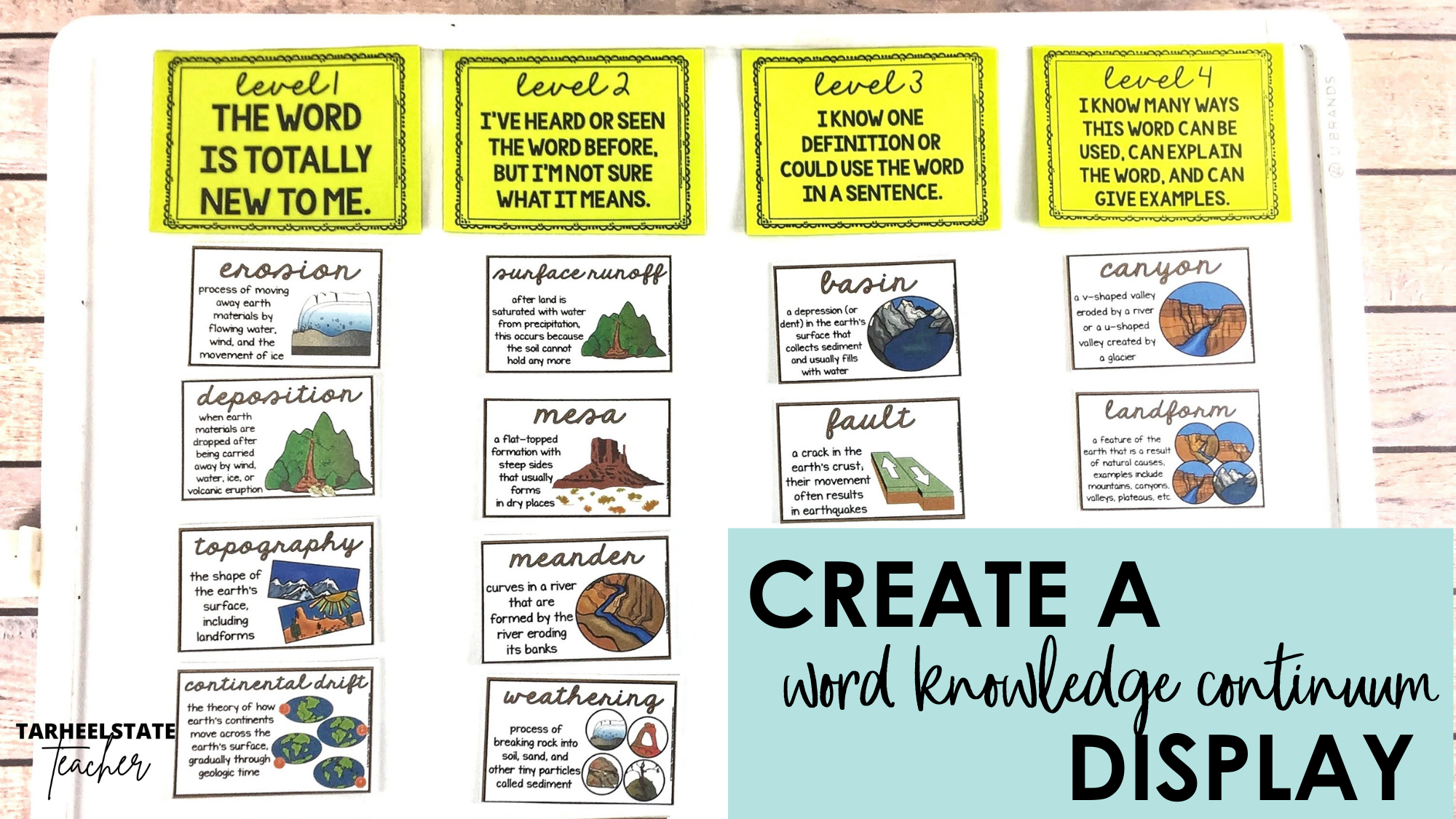
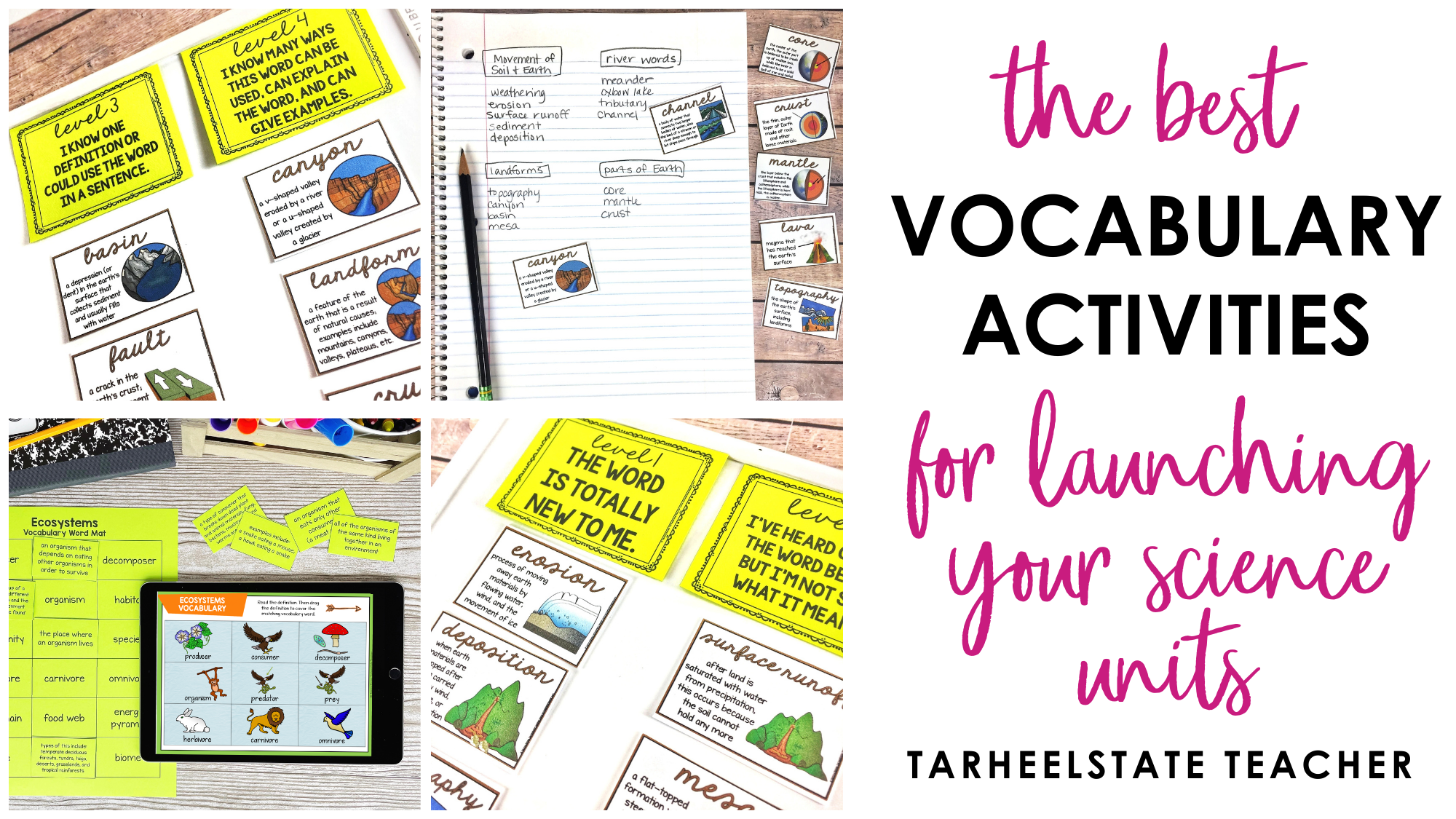
Using the list of words I have drafted, I play a game of 4 corners with my students using the 4 levels of word knowledge:
1) The word is totally new to me
2) I’ve heard or seen the word before, but I’m not sure what it means.
3) I know one definition could use the word in a sentence.
4) I know many ways this word can be used, can explain the word, and can give examples.
I post these posters in the corners of the room and have students move around to their “word knowledge” comfort level as I call out the vocabulary words. (I use a bell to get their attention when they have moved to a new spot and are noisy. I try to keep the game moving, and I am also taking mental notes on the words that students think they know and the words that are new to nearly everyone).
After the 4-Corners game is over, I like to make a class word knowledge continuum to post in the room. I tend to go on the lower end of where most of students feel their comfort level is with the words. This makes a great classroom display that you can refer back to again and again as you work through your unit, moving the words as students’ word knowledge increases.
ACTIVITY #2: CATEGORIZE AND LABEL
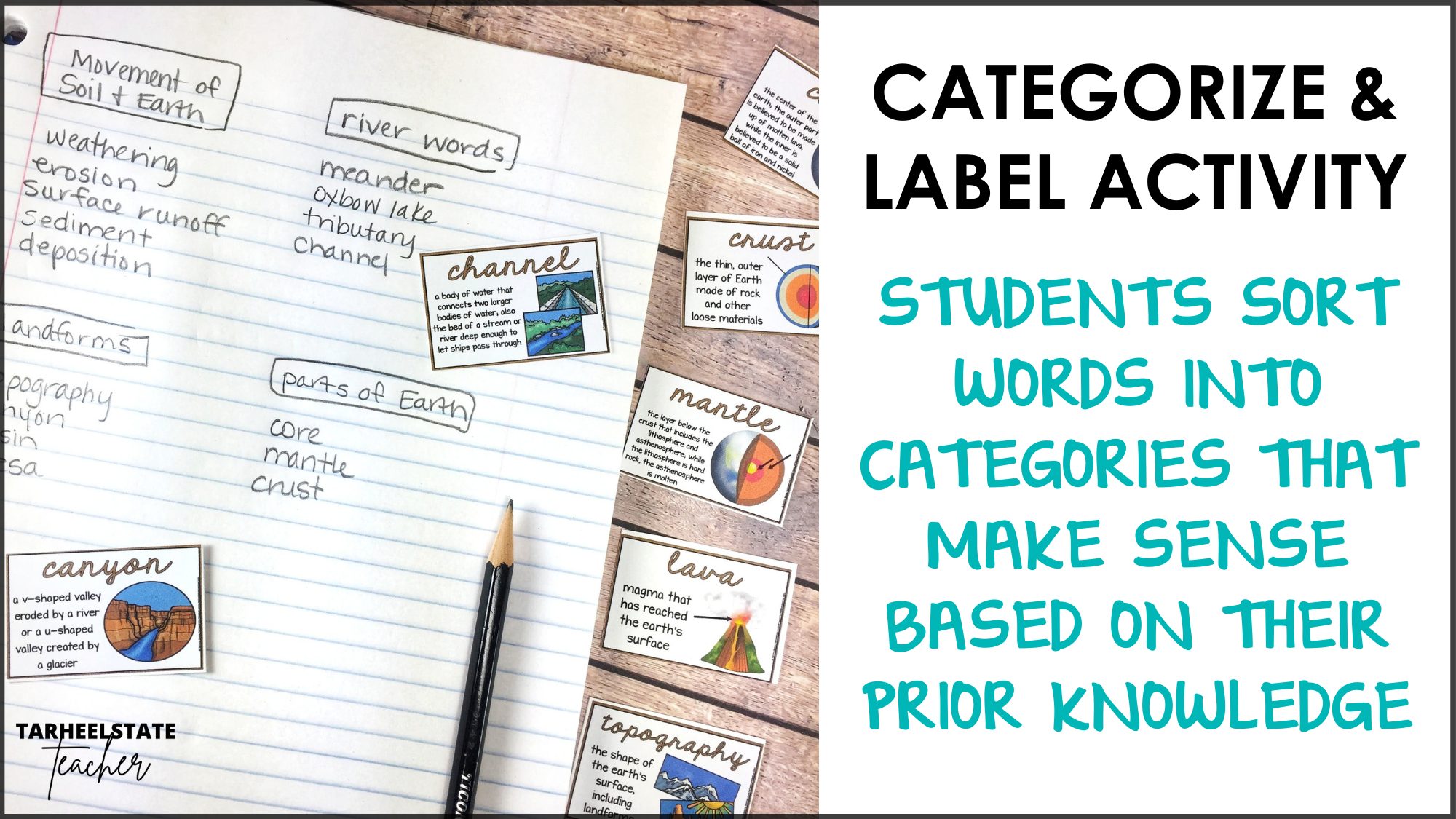
Once students have had some exposure to the words, I give them a copy of the vocabulary and have them sort the words independently into groups that make sense based on prior knowledge, then write a label or phrase for each group.
I use it at the start of a unit, but it’s also great during the unit to show growth: students’ groupings should get more precise and relationship-based as they learn. Two ways I’ve made it more interactive:
- Vocabulary cards on cardstock so students can physically move words between groups as they reconsider.
- A silent human sort, give each student a word and have them group themselves around the room without talking. I tack the groupings to a bulletin board and we keep rearranging them as we learn.
ACTIVITY #3: VOCABULARY MATS
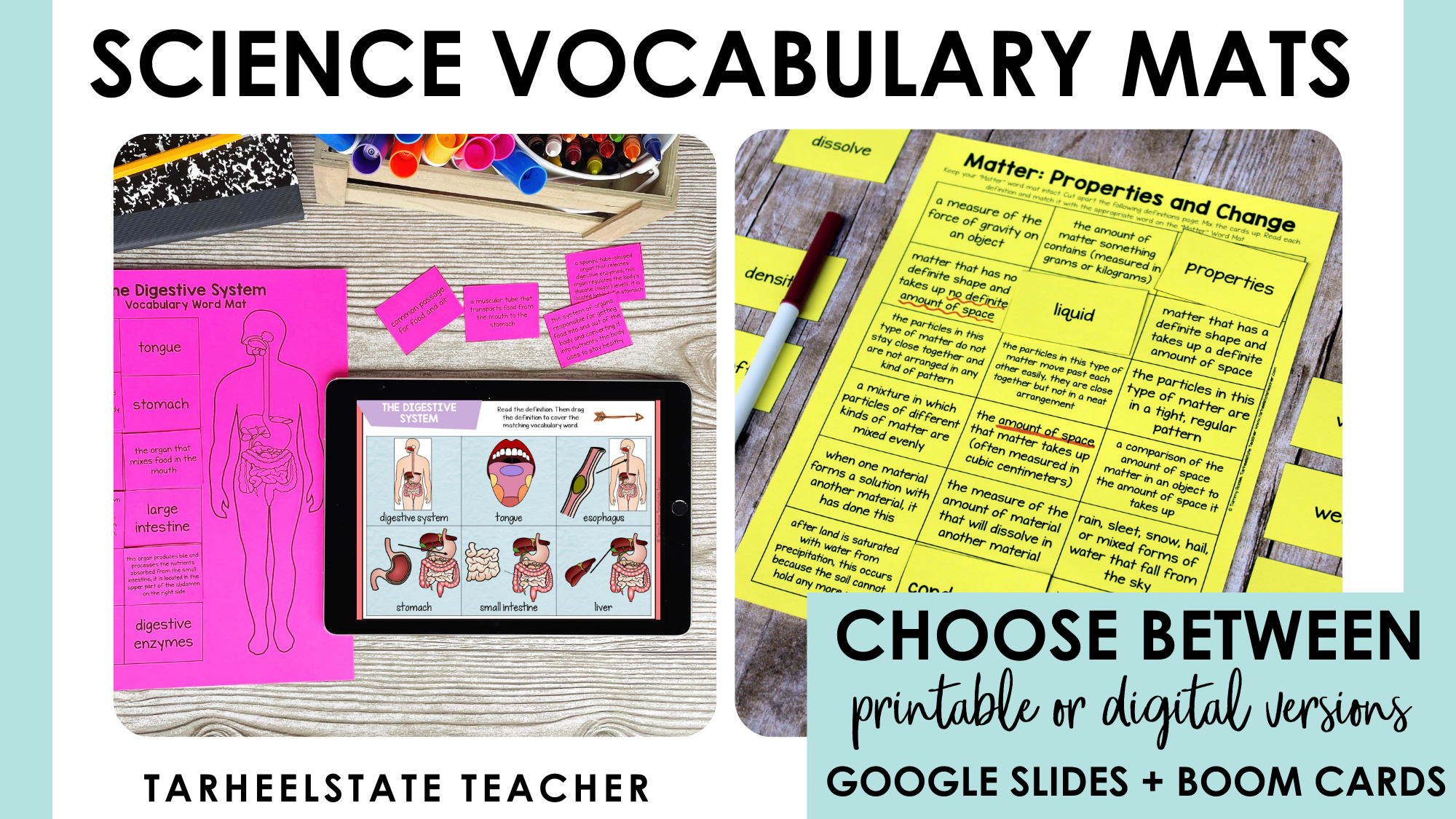
Vocabulary mats are the one science vocabulary strategy I can’t teach without. If you do nothing else from this post, consider this one.
The short version: a mat holds the unit’s vocabulary words (kept intact), and a separate set of definition cards is cut apart. Students lay each definition onto the word they think it describes. I have students cut apart the definitions rather than the words, because it forces them to actually read each definition as they sort. Used in the first week, it’s a great pre-assessment, then I pull it out again and again so students build mastery and move more words into long-term memory each time. Watching that growth is one of my favorite things in teaching.
Watch the video below to see the vocabulary mats strategy in action – then keep reading to learn more!
Years ago, in response to our state science test for 5th graders, I came up with Vocabulary Mats as an alternative to flash cards or match up games where students have both the vocabulary word and the definition cards cut apart. I have found that too many cards can be a lot to manage and really impede students’ ability to study their vocabulary words.
To use the vocabulary mats, the “mat” that contains the vocabulary words stays intact. The definitions are on another mat and are cut apart.
Why do I have students cut apart the definitions versus the words? I have found that this encourages and forces students to have to read the definitions when they are sorting cards onto the mats.
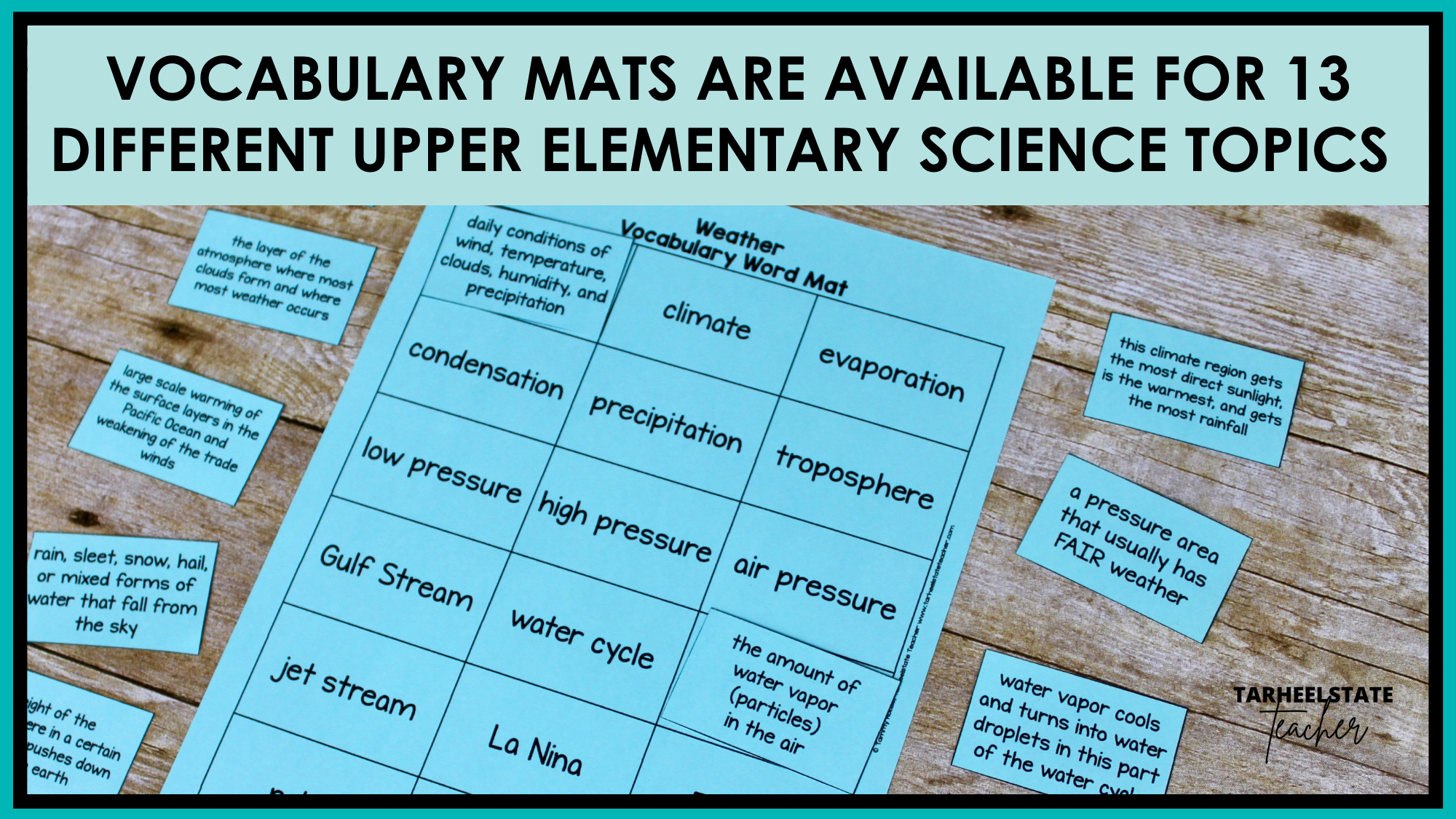
To use this activity to assess and activate prior knowledge, I have students prepare their mat activity during the first week of our unit (after completing activity 1-2 above).
Students read the definitions and lay them onto the vocabulary word that they think is being described. This is a great way to see how well students know the vocabulary and it is a good PRE-ASSESSMENT before you get into your learning activities for the unit.
I like to pull this activity out again and again so that students demonstrate greater mastery of the vocabulary words and get more practice with matching them up.
Each time students get to engage with their vocabulary mat, they 1) find that they have mastered new words and 2) they have the opportunity to add a few more words to their long-term memory files.
SEEING MY STUDENTS MAKE PROGRESS on just about anything makes my heart happy! And, vocabulary mats are one of the places in my teaching where I know students are showing growth!
MORE SCIENCE VOCABULARY IDEAS
This is part of a short science vocabulary series. You may also want to read:
→ A Process for Identifying Your Tier 3 (KEY) Content-Area Vocabulary
→ More about Vocabulary Mats: My FAVORITE Science Study Strategy
SHOP SCIENCE VOCABULARY RESOURCES
Here’s the handy part: my Science Vocabulary Mats resource works for all three activities in this post, not just the mats. Make extra copies of the word lists and you can use them for the knowledge continuum and the categorize-and-label sort too. Each set includes:
- Vocabulary mats with cut-apart definition cards
- Word lists you can reuse for sorting and continuum activities
- “Study slips” for extra practice
- Multiple-choice and fill-in-the-blank vocabulary quizzes
- Google Slides versions of the mats
- A Google Form quiz for digital assessment