Kids run into conflict every day: two siblings who both want the tablet, friends who can’t agree on the rules of a game, or a group project where nobody wants to give up their idea.
Most kids don’t yet know what to do in those moments. They yell, give in, walk away, or dig in until an adult steps in. Conflict resolution skills like calming down, listening, and finding a fair compromise take practice.
Based on my classroom experience and being a mom, I know that kids can learn to work through disagreements calmly and fairly when an adult guides them in how to do so and gives them chances to practice.
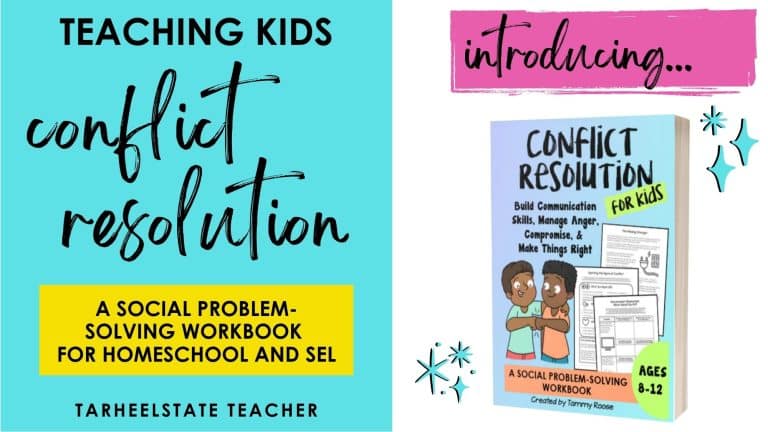
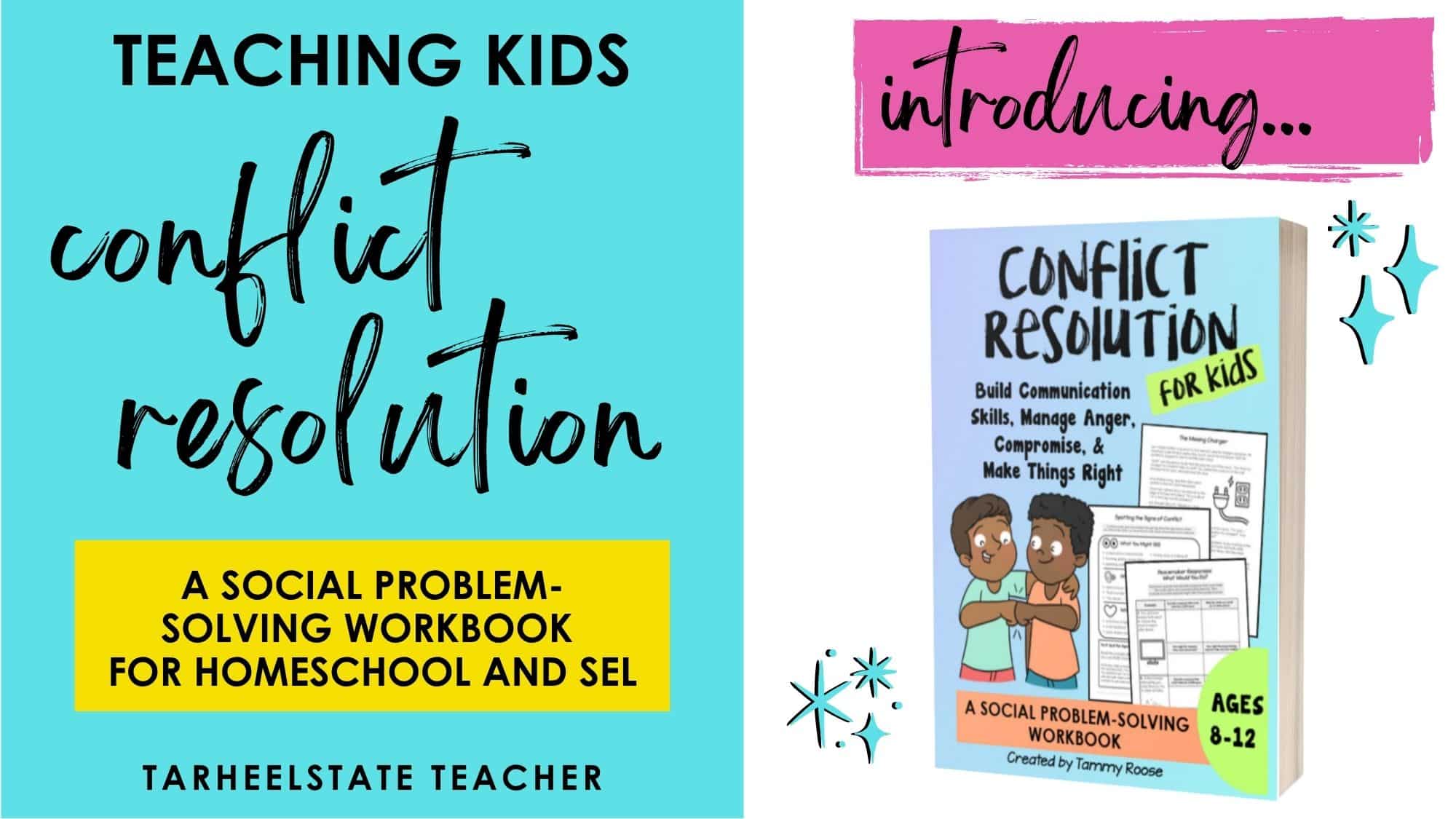
That’s why I created Conflict Resolution for Kids, a social problem-solving workbook designed to help children ages 8–12 strengthen communication skills, manage anger, practice compromise, and make things right after a disagreement. Kids learn five steps they can use in almost any disagreement: Cool Down, Size It Up, Talk It Out, Solve It, and Make It Right.
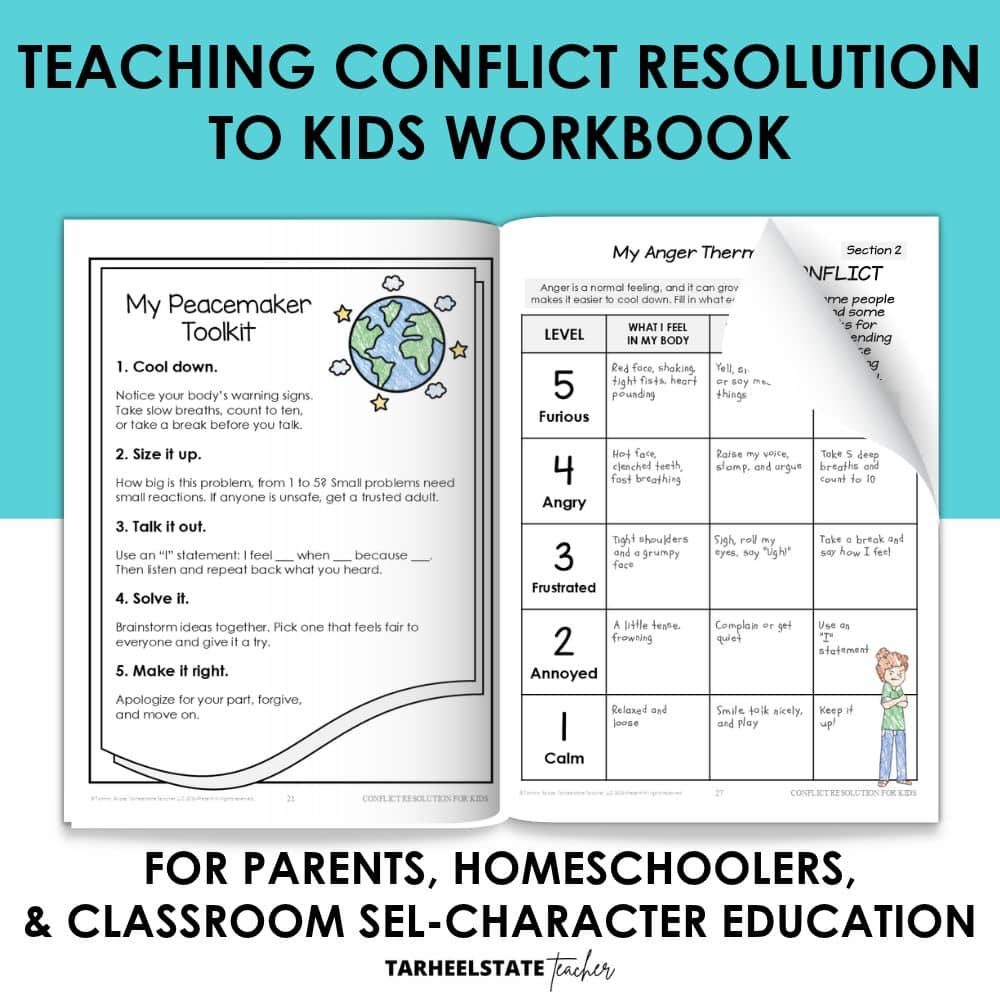
Through stories, real-life scenarios, and practice conversations, kids work on handling disagreements at home, at school, and with friends.
Note: Links to suggested items in this post are affiliate links. This means that I am a participant in the Amazon’s Affiliate advertising program that allows sites to earn from qualifying purchases. These links do not increase your cost. I only recommend things I’ve used and love! Read my full disclosure here.
WHAT IS CONFLICT RESOLUTION?
Conflict resolution is the process of working through a disagreement so that both people feel heard and can agree on a solution. In the workbook, I explain it to kids this way: a conflict happens when people want or need different things, and resolution means finding an answer you can both live with.
Sometimes that answer takes compromise. In a compromise, each person gives up a little of what they want so that everyone gets part of what they want.
WHY CONFLICT RESOLUTION SKILLS MATTER FOR KIDS
Upper elementary students spend more time having to negotiate the wants and needs of themselves and others, whether it’s while working in a group, playing on a team, or hanging out with a friend. Disagreements happen in all of those settings, and how kids respond to a disagreement affects how big of a problem it becomes, whether the friendship survives, or whether or not the group assignment keeps moving along.
When kids learn conflict resolution skills, they begin to:
- Calm down before they react
- Listen to the other person’s side
- Use “I” statements instead of blaming words
- Find compromises that feel fair to everyone
- Apologize sincerely and forgive
These are all skills kids learn in this workbook through the Peacemaker Toolkit.
A WORKBOOK THAT HELPS KIDS PRACTICE REAL-LIFE CONFLICT RESOLUTION
This workbook goes deeper than telling kids to “just get along.” It gives them practical strategies for resolving conflicts they can use during most disagreements or challenges.
Inside, kids will learn how to:
- Recognize the early signs that a conflict is starting
- Use the five conflict resolution steps of the Peacemaker Toolkit
- Notice what sets off their anger and how it grows
- Make a calm-down plan
- Size up a problem and choose a reaction that matches it
- Repeat back what they heard so the other person feels listened to
- Stay calm when the other person says “whatever” or won’t talk
- Understand the five conflict resolution styles and when each one fits
- Brainstorm solutions and find a fair compromise
- Give a sincere apology and understand what forgiveness really means
- Set goals for handling conflict in the future
By the end, children have practiced each skill with scenarios that look a lot like their own lives.
INSIDE THE WORKBOOK: WHAT KIDS WILL EXPLORE
This workbook is organized into five sections that build on one another as kids practice applying the steps to the Peacemaker Toolkit. They start by learning what conflict is and leave the workbook with strategies for handling disagreements on their own.
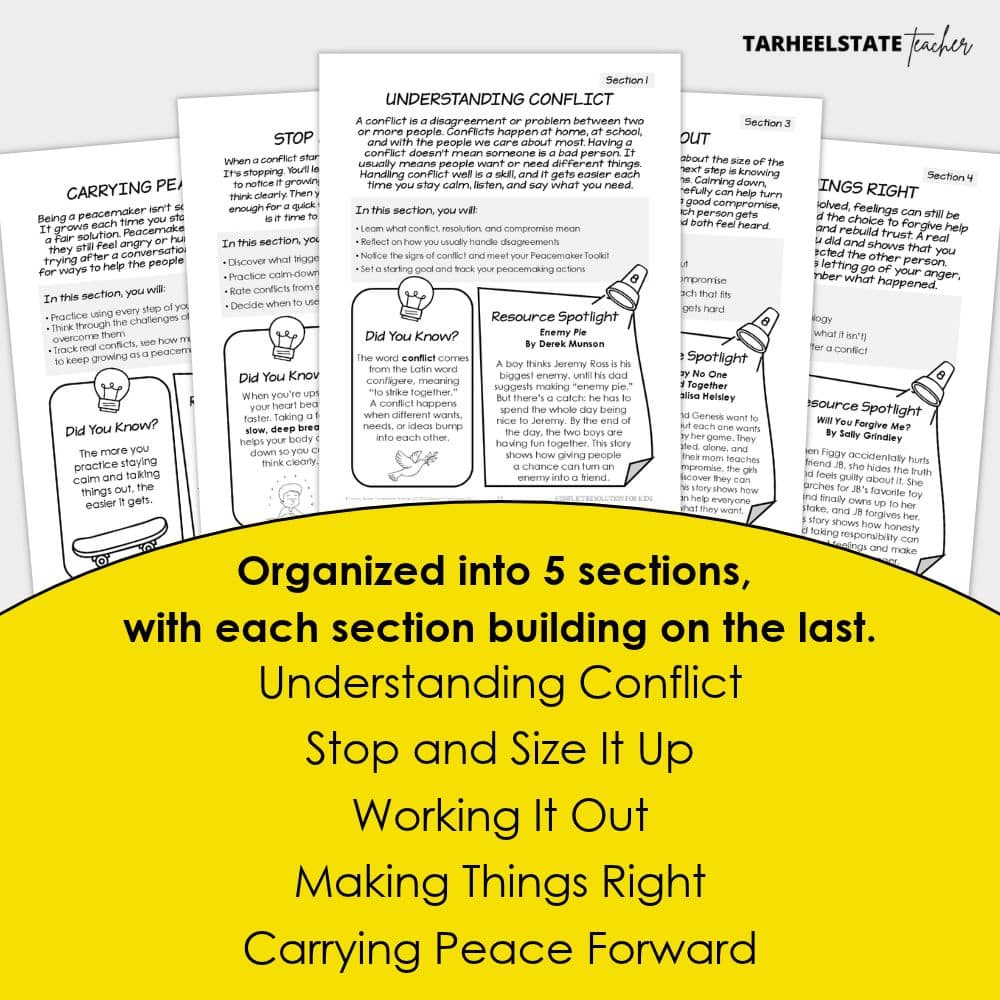
1 – UNDERSTANDING CONFLICT
Kids begin by learning what conflict, resolution, and compromise mean. They reflect on how they usually handle disagreements, share their beliefs about conflict, and learn to notice the signs that a conflict is starting, like crossed arms, raised voices, or a knot in your stomach.
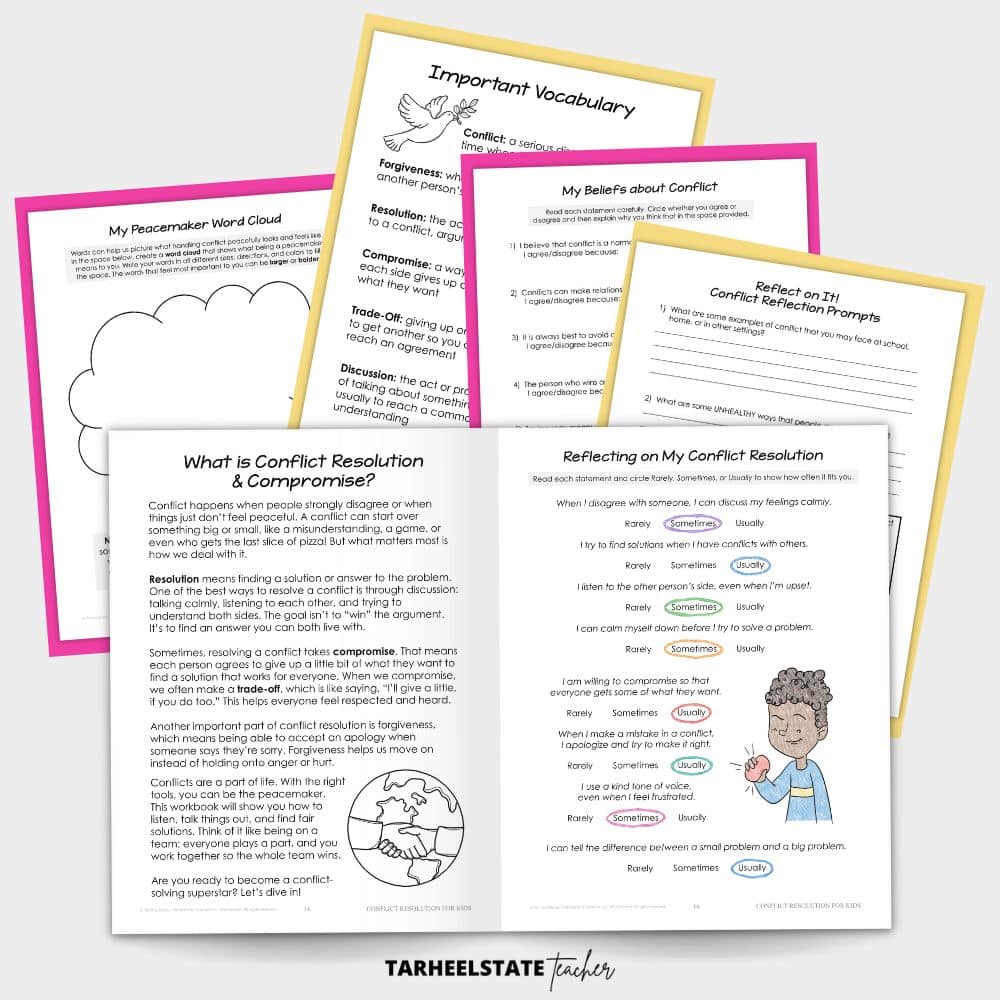
In Reflecting on My Conflict Resolution and My Beliefs about Conflict kids take a closer look at how they typically respond to disagreements. Spotting the Signs of Conflict helps them see when anger may be rising during a disagreement. Conflict is a normal part of life and handling conflict well is a skill we can all improve.
Kids are also introduced to the Peacemaker Toolkit, the five steps they’ll practice throughout the workbook:
1. Cool down.
2. Size it up.
3. Talk it out.
4. Solve it.
5. Make it right.
Kids also get a monthly Peacemaker Action Tracker to record which steps they’ve used in real-life situations. These early pages set up the strategies kids will learn to apply in the rest of the workbook.
2 – STOP AND SIZE IT UP
Before kids can work through a disagreement, they need to recognize when they’re getting upset and know how to calm themselves down. They explore what triggers their anger, notice how their bodies feel as anger builds, and consider the difference between feeling angry and lashing out. They also create their own Calm-Down Toolbox with three strategies they can turn to when they start getting upset, then practice choosing the right strategy for different situations.
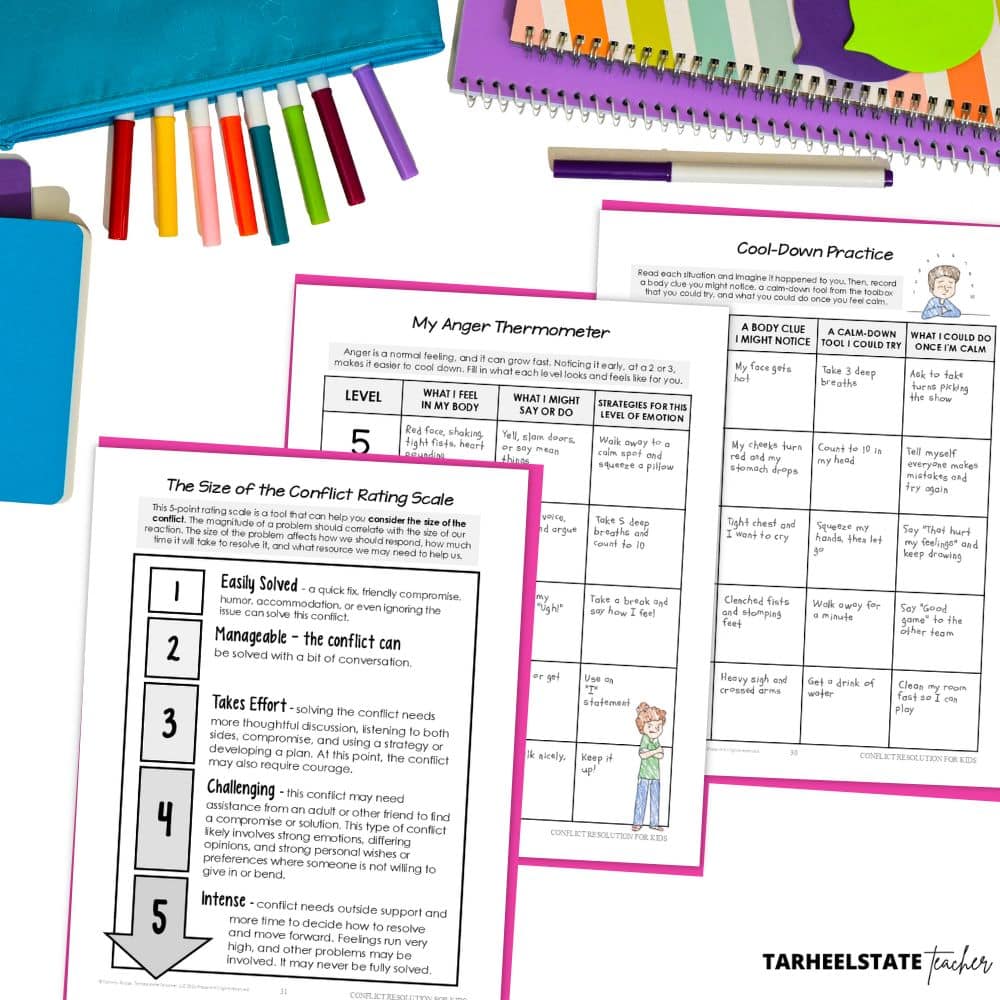
Next, kids use a five-level scale, from Easily Solved to Intense, to rate problems. In The Missing Charger, Leo rates his problem a 1 and his reaction a 4. Later, when older kids keep grabbing his hat at the bus stop, he decides that problem is a 4 and asks his mom for help. Kids also learn quick fixes for smaller disagreements, like taking turns or flipping a coin, and practice deciding when they can solve a problem on their own or need an adult’s help. By the end of this section, kids have worked through many scenarios, have a calm-down plan, and understand the concept of how big a problem is.
3 – WORKING IT OUT
Once kids are calm and have sized up the problem, they’re ready to work it out. Kids see the toolkit steps in action in a story called The Backyard Fort, where two cousins argue over whether their fort should be a castle or a spaceship. When the cousins eventually settle on a space castle as a solution, kids can see a tangible example of compromise.
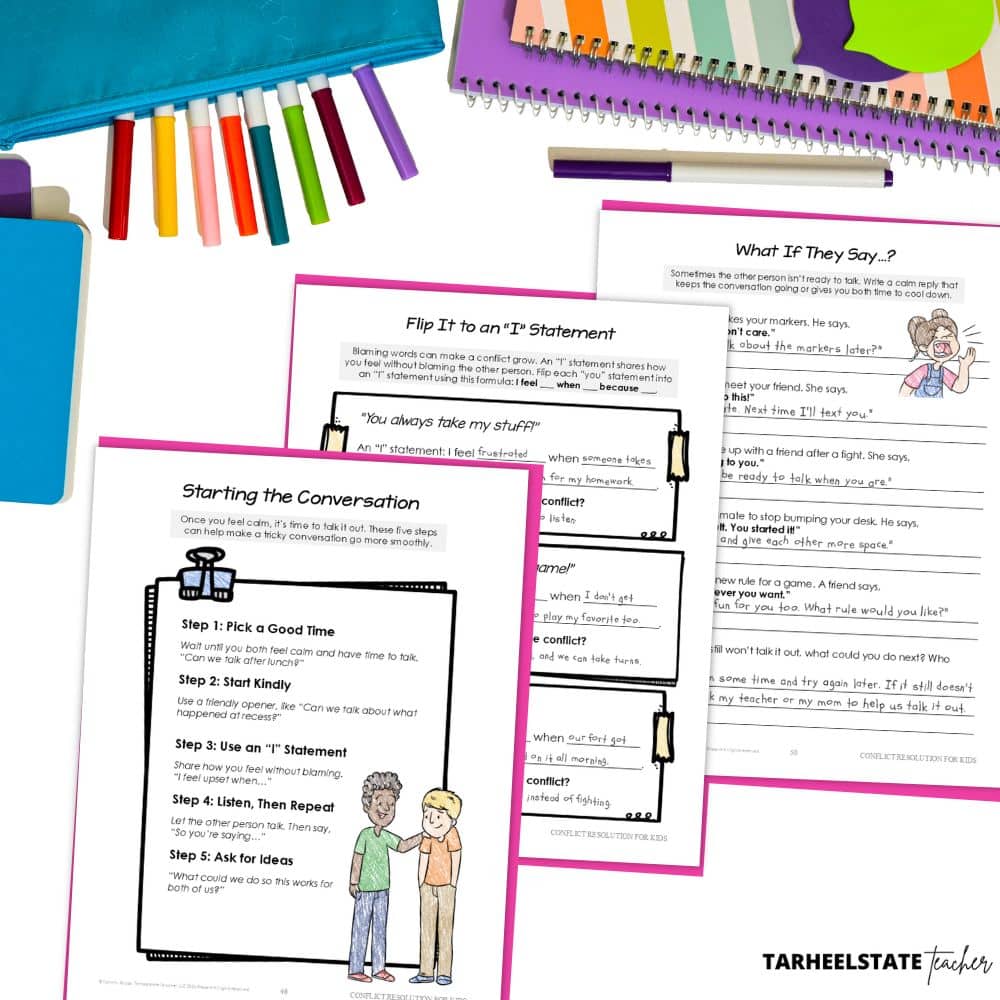
Kids practice starting difficult conversations, turning blaming statements into ‘I’ statements, and repeating back what someone said to show they’re listening. What If They Say…? gives them practice writing calm replies for when someone says “Whatever!” or “I’m not talking to you.”
Later, kids brainstorm ideas and use Which Approach Fits? to choose among the five conflict resolution styles: accommodating, avoiding, compromising, collaborating, and competing.
They see how each style could play out when two friends, Nadia and Jess, want to spend their Saturday together differently. They also sort conflict resolution examples for students in the Conflict Approach Scenarios Sort and read The Tablet Tug-of-War, a story about a brother and sister who fight over the family tablet until they come up with a better plan.
Through Flipping to an Attitude of Compromise and What Would You Do? kids get more practice considering both people’s perspectives, making compromises, finding solutions that are fair to both people, and deciding what they would actually say in a disagreement.
4 – MAKING THINGS RIGHT
Even after a conflict is solved, feelings can still be hurt. Kids learn the Steps for a Good Apology and read The Science of Saying Sorry, an article about why some apologies work better than others and why “I’m sorry, but…” can make a conflict worse.
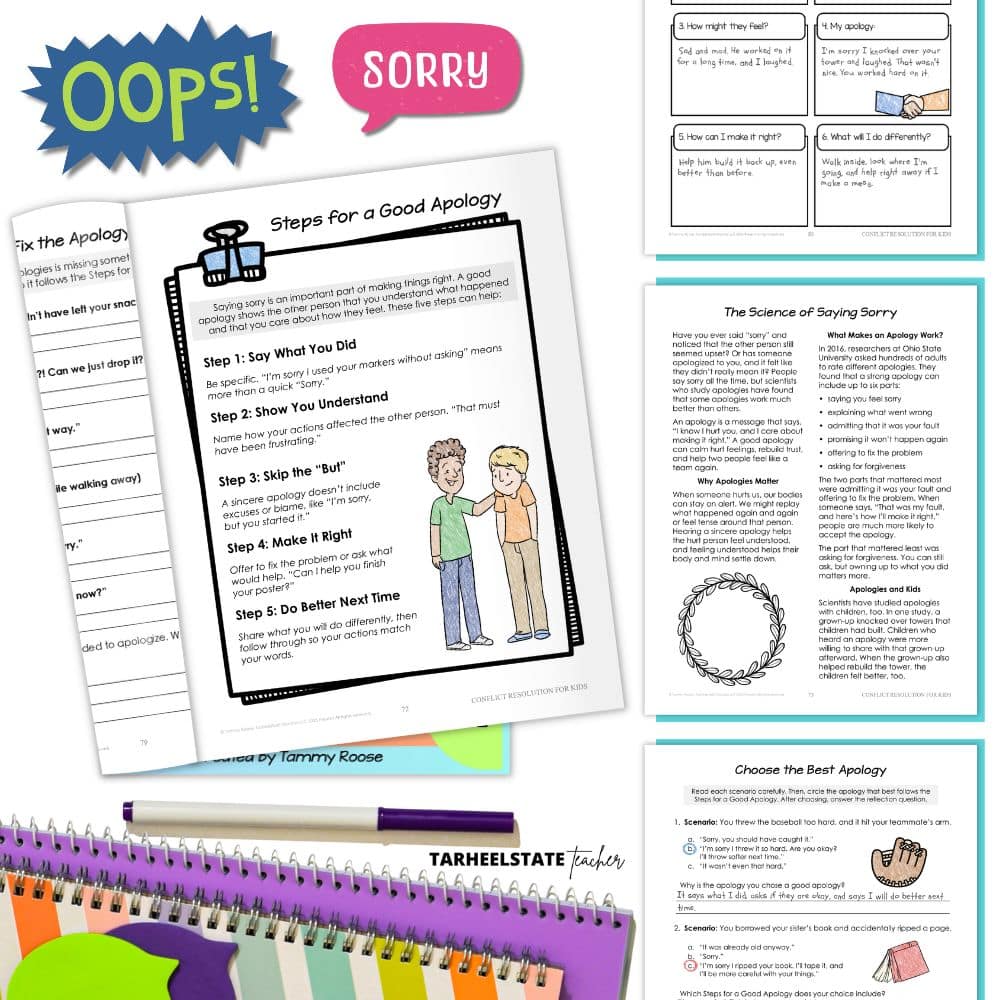
Kids get a lot of practice with learning to apologize in this section. They compare apologies to decide which ones sound sincere, rewrite ones that miss the mark, and create their own plan for making things right. They also explore what forgiveness means—and what it doesn’t mean. After completing this section, kids are better equipped with the words they need for apologies and a clearer idea of what forgiveness means.
5 – CARRYING PEACE FORWARD
In the final section, kids use every toolkit step on one conflict in Putting It All Together. They use My Conflict Debrief Log to reflect on disagreements they’ve experienced and revisit their original self-rating in Looking Back to see whether their responses to conflict have changed. They also pull together their learning through engaging activities like the ABC’s of Peacemaking, the Peacemaker Word Cloud, and with suggested actions from the Conflict Resolution Choice Board.
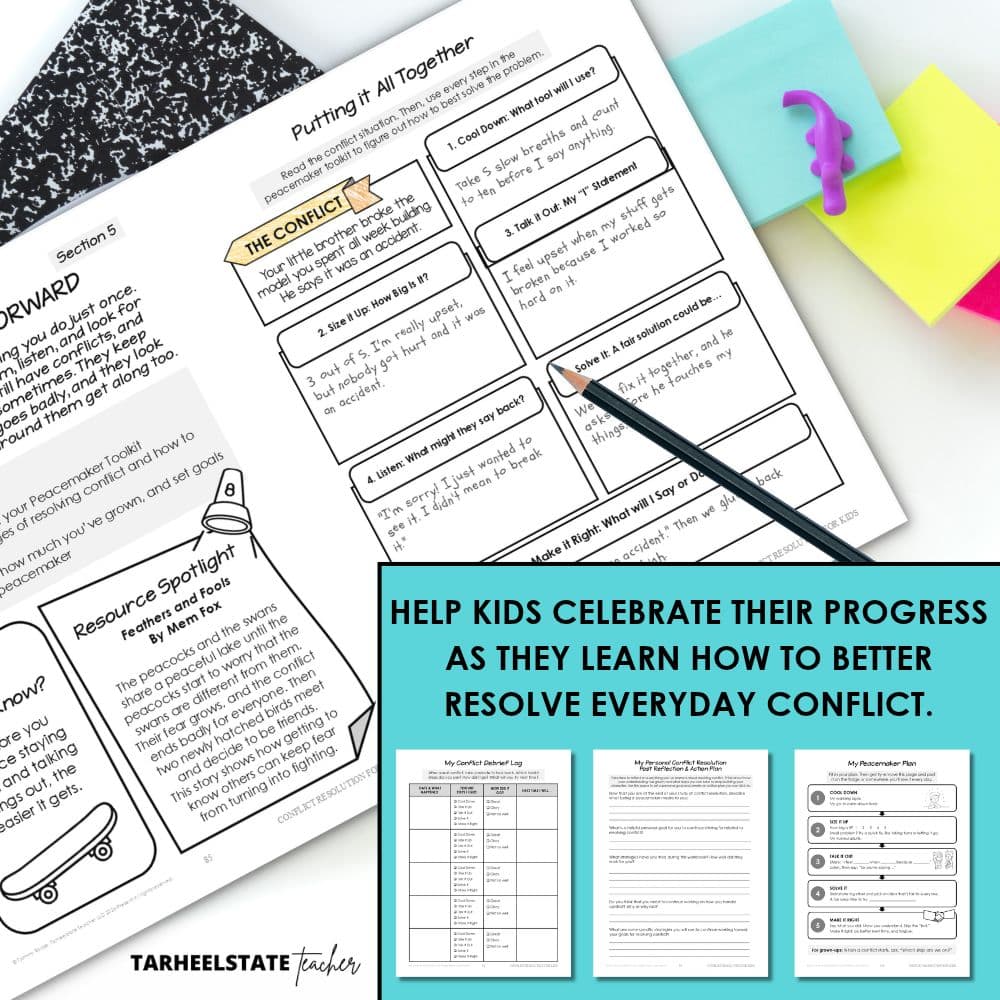
Through the Post Reflection & Action Plan, the Weekly Goal Reflection, and My Commitment to Resolving Conflict, kids set goals for handling disagreements after the workbook is finished. The appendix includes My Peacemaker Plan, a one-page version of the five steps to post on the fridge.
CONFLICT RESOLUTION PICTURE BOOKS THAT BRING THE LESSONS TO LIFE
Picture books give kids a chance to watch characters work through a conflict before they try it themselves. Each section of the workbook is paired with a read-aloud, and you’ll find an extended list of conflict resolution books in the back of the workbook.
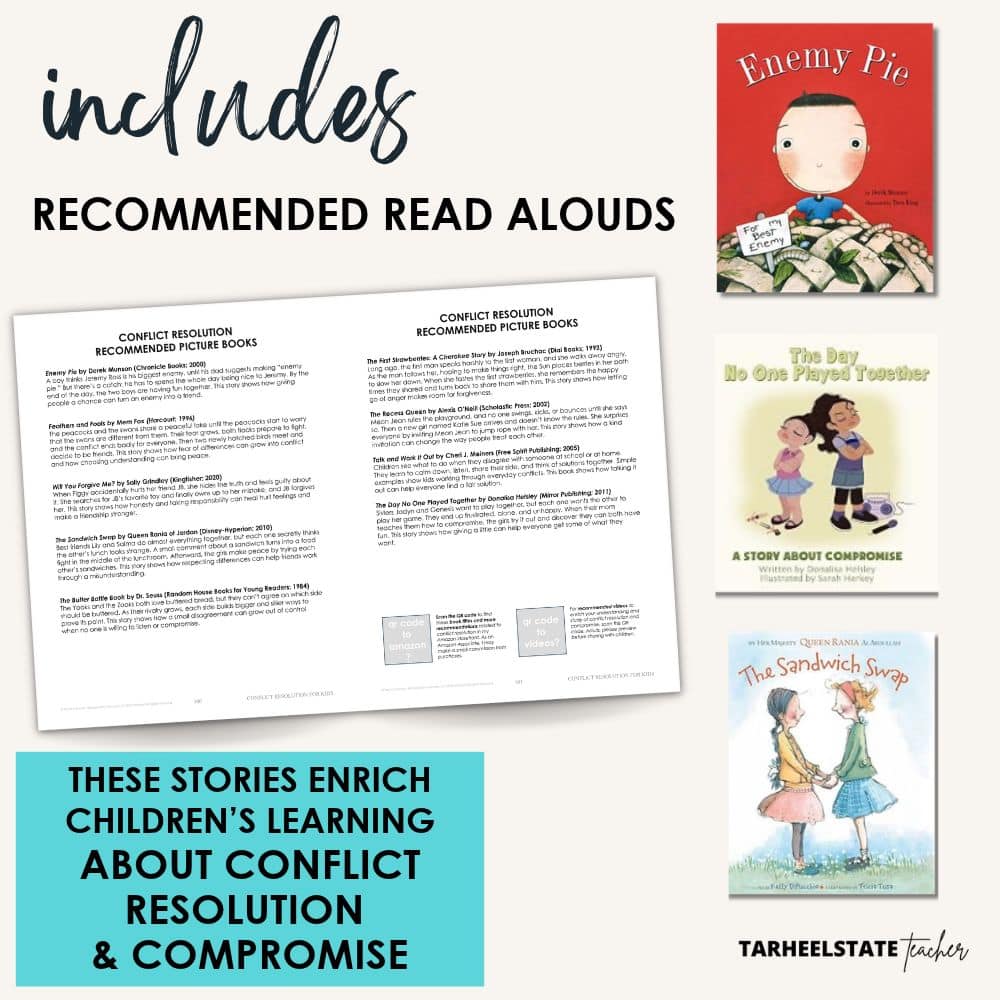
Here are three of my favorites:
Enemy Pie by Derek Munson
A boy thinks Jeremy Ross is his biggest enemy, until his dad suggests making “enemy pie.” But there’s a catch: he has to spend the whole day being nice to Jeremy. By the end of the day, the two boys are having fun together. This story shows how giving people a chance can turn an enemy into a friend.
The Sandwich Swap by Queen Rania of Jordan
Best friends Lily and Salma do almost everything together, but each one secretly thinks the other’s lunch looks strange. A small comment about a sandwich turns into an argument that spreads across the whole lunchroom. This story shows how a small disagreement can grow when we don’t talk it through and how friends can make things right.
The Day No One Played Together by Donalisa Helsley
Sisters Jadyn and Genesis want to play together, but each one wants the other to play her game. They end up frustrated, alone, and unhappy. When their mom teaches them how to compromise, the girls try it out and discover they can both have fun. This story shows how giving a little can help everyone get some of what they want.
HOW TO USE THIS WORKBOOK
Whether you’re talking through a sibling argument at home, teaching in a homeschool setting, or guiding a classroom community, this workbook is flexible and easy to use. For best results, revisit the activities and discussions 3–4 times each week so kids have time to try the skills between sessions.
FOR PARENTS AND GUARDIANS
Try weaving conflict resolution practice into everyday family moments:
- When a disagreement starts, ask, “Which step are we on?”
- When siblings argue, ask, “On a scale of 1 to 5, how big is this problem?” and talk about a reaction that fits
- Practice flipping “You always…” statements into “I feel…” statements at dinner
- Read The Backyard Fort or The Tablet Tug-of-War together and talk about what each character gave up in the compromise
- Use My Calm-Down Toolbox to make a family calm-down plan
- Write down a toolkit step on the Peacemaker Action Tracker before bedtime
- Post My Peacemaker Plan on the fridge
The goal is helping your child stay calm, listen, and look for a fair solution, even when they still feel upset.
FOR HOMESCHOOL OR CO-OP EDUCATORS
Conflict resolution activities work well in group settings, where real disagreements come up naturally:
- Pair each section with its recommended read-aloud
- Use the Conflict Approach Scenarios for group sorting and discussion
- Role-play the Peacemaker Responses scenarios
- Use What If They Say…? for partner practice
- Turn the ABC’s of Peacemaking into a group poster
This resource gives co-op groups shared language, like the Peacemaker Toolkit, “I” statements, and the size of the problem, for working through disagreements together.
FOR CLASSROOM TEACHERS
This workbook was designed based on my SEL Morning Meeting Unit for Conflict Resolution, making it a natural fit for teaching conflict resolution in the classroom. Whether used during morning meetings, counseling groups, or SEL instruction, each activity gives students practice with the five steps of the Peacemaker Toolkit, “I” statements, and compromise.
Activities such as Spotting the Signs of Conflict, Size of the Problem, Size of the Reaction, and Choose the Best Apology connect easily to class discussions about recess disagreements and group work. Students leave with shared language you can return to all year when conflict resolution in the classroom comes up.
NOTE: The digital download version on Shopify includes daily lesson plans, printable student journals, a bulletin board, and a Google Slides component. Consider whether the workbook curriculum or Shopify version will best meet your needs.
INTERESTED IN MULTIPLE COPIES?
Contact Tammy at tarheelstateteacher(at)gmail(.)com for a quote for multiple copies or purchase orders for your campus or district.
WHY FAMILIES VALUE CONFLICT RESOLUTION SEL
Families and educators often share that learning strategies for resolving conflicts helps children:
- Calm down before reacting
- Talk through problems instead of arguing
- Share and take turns more fairly
- Apologize sincerely and forgive
- Handle disagreements with friends on their own
Handling conflict gets easier each time kids practice staying calm, listening, and looking for a fair solution.
FEEDBACK FOR MY CONFLICT RESOLUTION UNIT FROM CLASSROOM TEACHERS
 This resource has been helpful in my problem solving student groups that helps differentiate between size of problem, solutions, and provides graphics and thought provoking questions for students to evaluate their response to conflict.
I love this resource. We have had some conflict in my classroom recently. The conflicts were interrupting our learning. I implemented this resource into the morning meeting, and I have seen a reduction in conflict.
One of the biggest pet peeves I have is issues happening at recess that should be able to be solved independently, but get carried into the classroom. This resource helped us discuss when is the appropriate time to bring it to a teacher or handle it independently.
START TEACHING CONFLICT RESOLUTION TODAY
If you are looking for a meaningful way to help children calm down, listen, compromise, and make things right, Conflict Resolution for Kids offers practical tools they can use the next time a disagreement starts.
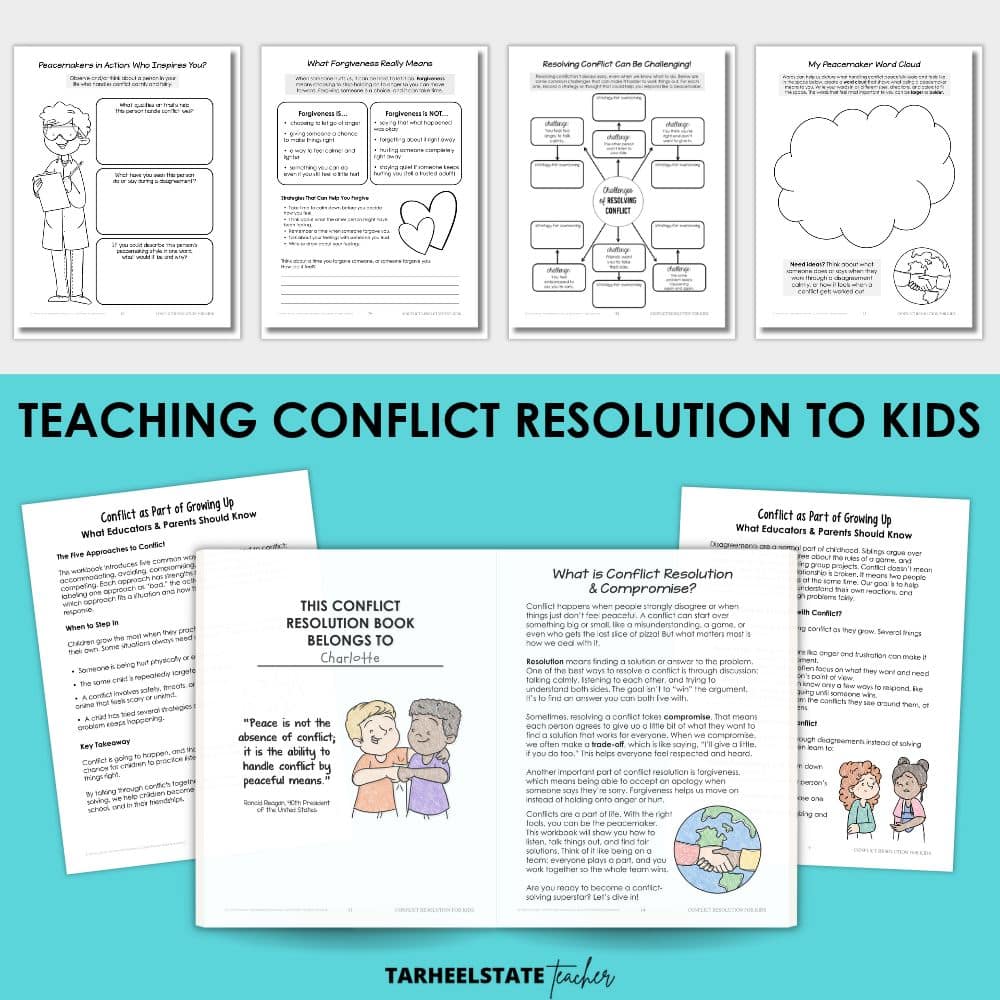
This conflict resolution workbook helps kids move from arguing over who’s right to working out a solution together.