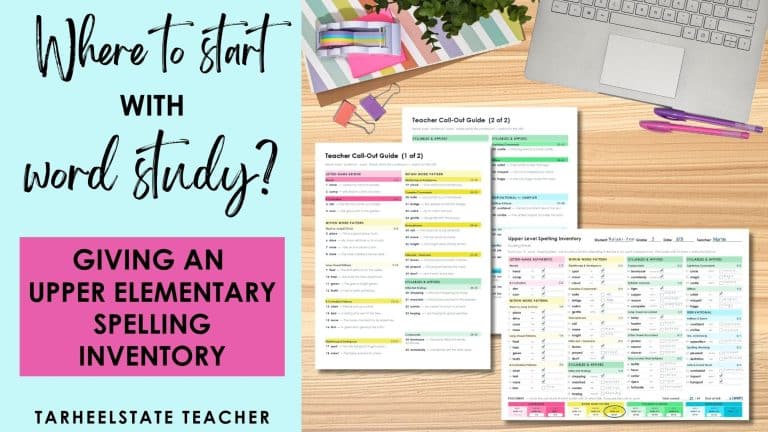
During the first few days of school, you can no doubt see the range of spellers in your classroom before you even have a single piece of data. One student is still mixing up long vowel patterns, while another spells most everything correctly and is ready for Latin roots. Our experience tells us that most classes will be a bit all over the place, but the harder part is figuring out what each student actually needs to work on to make progress. An upper elementary spelling inventory helps you figure out what spelling patterns students have already mastered–and more importantly, where you need to start teaching. Before I launch my word study routine, I give the Upper Elementary Engaged Spelling inventory so that I have the data to guide me.
I give this spelling inventory during the first three days of my word study launch plan. When teachers ask me where to start with word study, I always ask if they have assessed their students. In this post, I’m walking you through each step of giving the inventory, along with why I created my own and how it compares to the Words Their Way spelling inventory.
If you have never given a spelling inventory before, let’s prep you and change that today!
WHY I CREATED MY OWN UPPER ELEMENTARY SPELLING INVENTORY
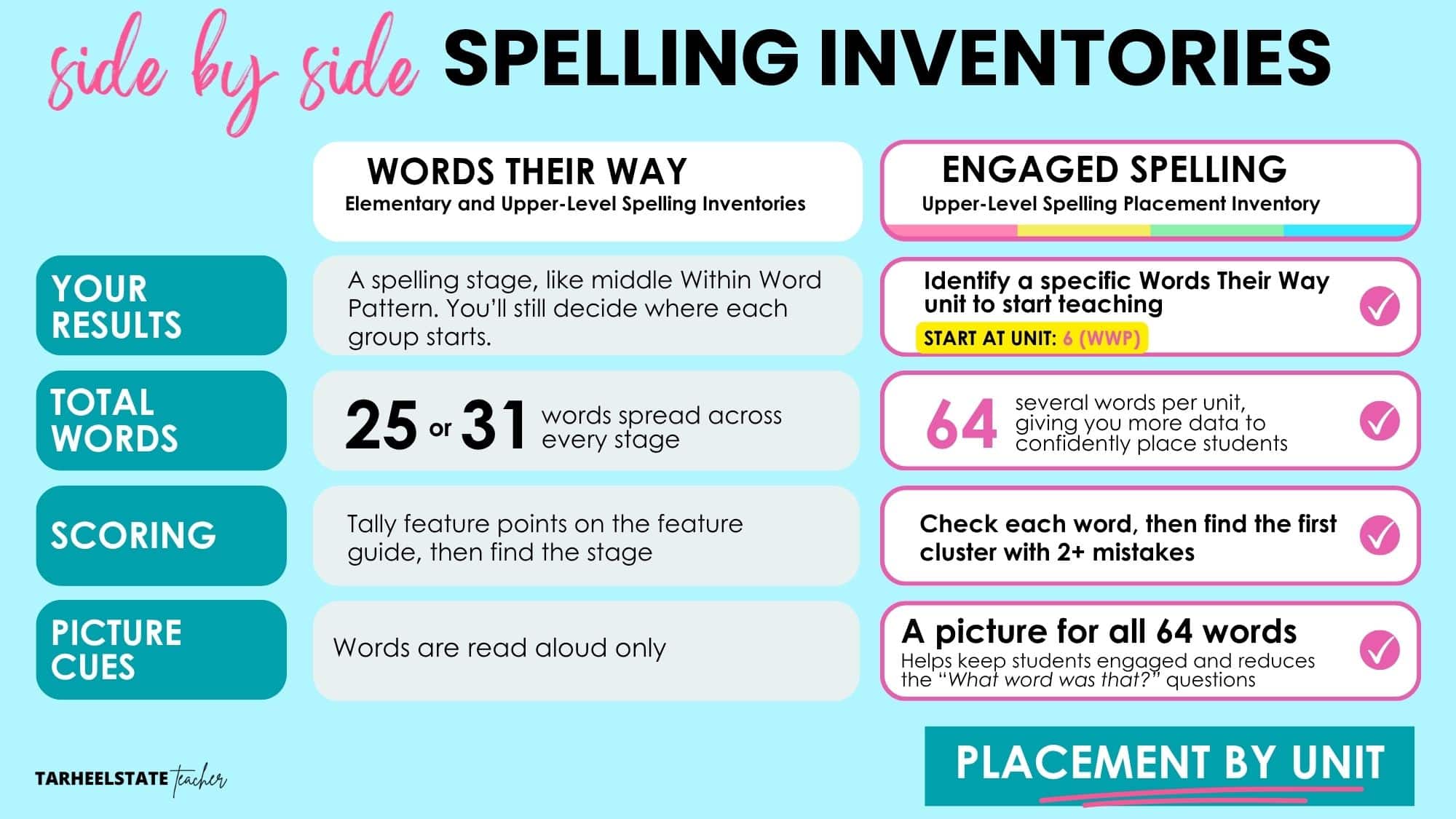
The Words Their Way spelling inventories are how many of us learned to think about spelling in developmental stages, and I used them for years. In upper elementary, teachers can choose from two Words Their Way inventories: the 25-word Elementary Spelling Inventory or the 31-word Upper-Level Spelling Inventory. With Words Their Way inventories, teachers score students’ spellings with a feature guide. By using the scoring guide, you can identify a student’s stage and whether they are early, middle, or late in that stage.
Grab your free upper elementary inventory 
Enter your email and I’ll send you directions for administering, your call-out guide, student recording sheets, charts for class data and small groups, and the kid-friendly call-out slides.
SUCCESS!!!
I'll be sending you an email right away with your copy of the Engaged Spelling Upper Level Inventory, your assessment slides, and the Teacher Call-Out & Scoring Guide!
If you do not see an email from Tarheelstate Teacher in the next 10 minutes, check your spam folder, then email me at tarheelstateteacher@gmail.com!
THE CHALLENGES OF USING THE WTW ASSESSMENT
Knowing a student’s spelling stage got me closer to differentiated spelling instruction, but I still had to decide what specific word list and unit students should start with. The Words Their Way inventory may show that a student is in the middle of the Within Word Pattern stage and still mixing up vowel patterns, but it doesn’t pinpoint a specific unit or word list. From there, I still had to decide which patterns to teach first, and make that decision for every student in my class.
The Engaged Spelling inventory is made up of 64 words organized in clusters, with each cluster tied to a specific Words Their Way unit. The first cluster where a student misses two or more words is most likely that student’s instructional level, and the unit that matches that cluster is where the student’s instruction should start. If you’ve used the Words Their Way feature guide, the two-or-more-errors rule will feel familiar. A unit number is more useful to me than a stage because I plan from units. When the scoring sheet says a group starts at Within Word Pattern Unit 4, I know which word list to start them on, and the activities I’ve made for those exact words are ready to print.
ASSESSING WITH MORE WORDS GIVES YOU A CLEARER PICTURE
The Words Their Way Elementary inventory uses 25 words to assess every stage from Letter Name-Alphabetic through Derivational Relations. With 36 units and 242 word lists, students’ many possible starting points are represented by only a few assessment words–or not represented at all. By comparison, the Engaged Spelling inventory tests 25 words for the Within Word Pattern stage alone, and another 27 for the Syllables and Affixes stage.
With several words for each unit, one careless mistake or one lucky guess has less effect on where a student is placed. The extra words also show you which patterns a student has mastered inside of a stage. For example, a student might spell every long vowel word correctly and still miss two of the complex consonant words, and the Engaged Spelling scoring sheet shows you both of those results.
A PICTURE CUE FOR EVERY WORD
The directions for the Words Their Way Upper-Level Spelling Inventory have you say each word, use the word in a sentence if needed, and say the word again. The Engaged Spelling inventory includes a slideshow with a picture for every word, giving students a visual cue as they hear each word.
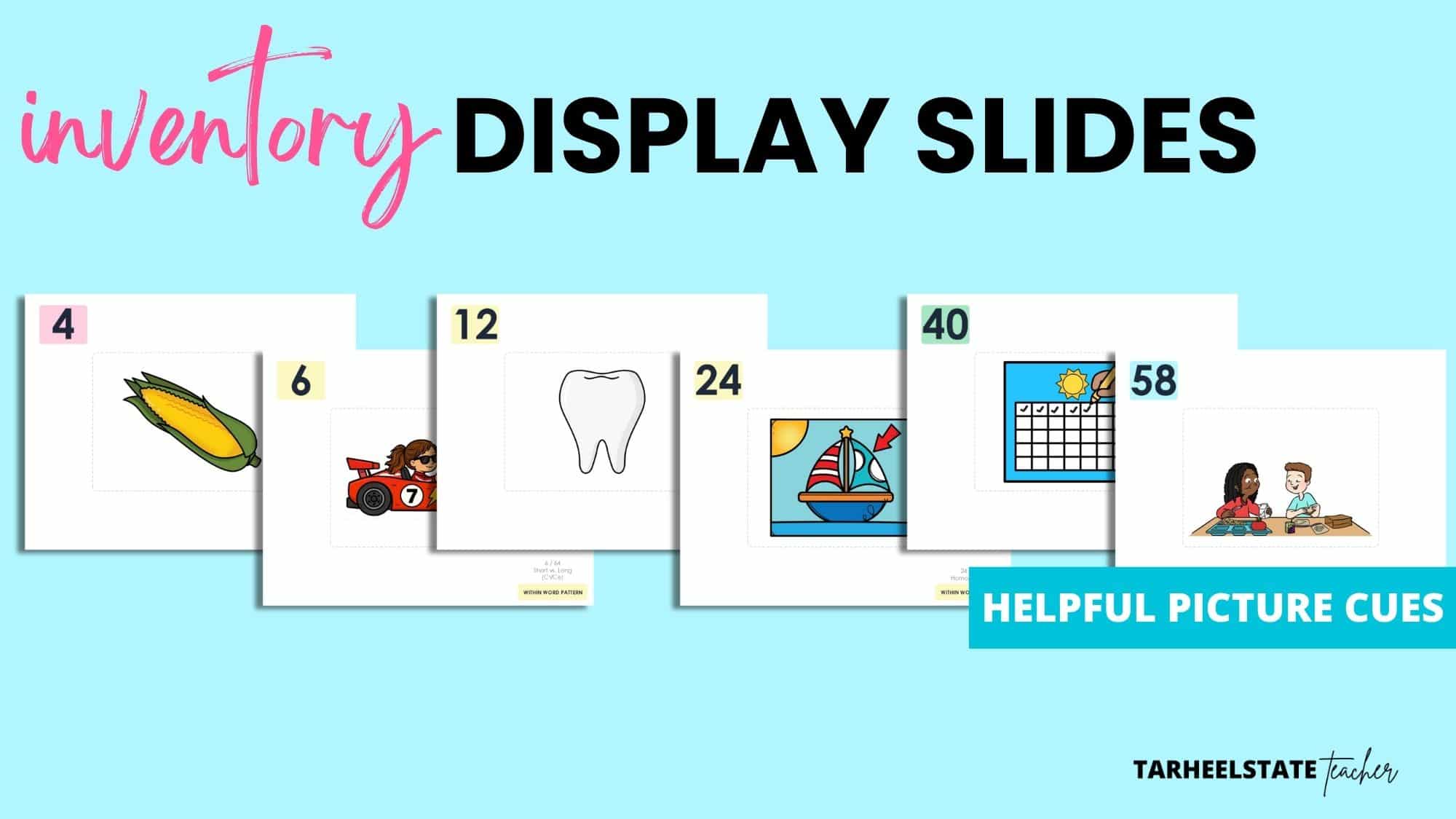
The picture cue helps students confirm which word they heard before they begin spelling while also keeping them engaged throughout the assessment. It can be especially helpful for English learners, students who need extra time to process what they hear, and homophones where meanings matter. When students are sure about which word you called, their spelling assessment gives you a more accurate picture. And, I hope it means you can move through the assessment more quickly with less “What was that word?”
HOW THE ENGAGED SPELLING INVENTORY COMPARES TO THE WORDS THEIR WAY SPELLING INVENTORIES
Both inventories work the same way: you call out words while students spell them. The difference is in the results you get once you score them. A Words Their Way feature guide tells you a student is in the middle of the Within Word Pattern stage. The Engaged Spelling scoring sheet tells you a specific starting place, like Syllables and Affixes at Unit 6.
WHAT’S INCLUDED IN THE UPPER-LEVEL SPELLING INVENTORY
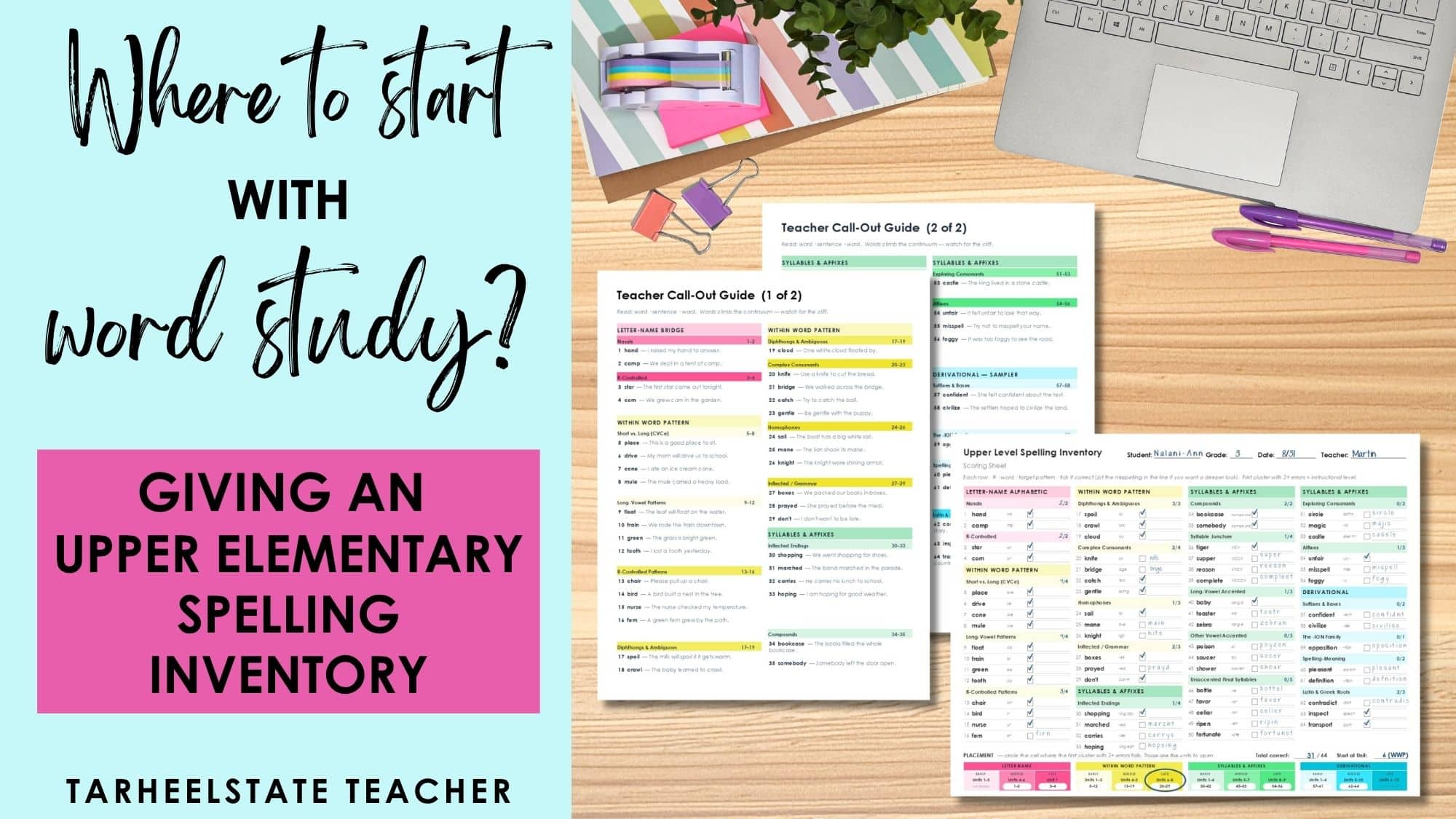
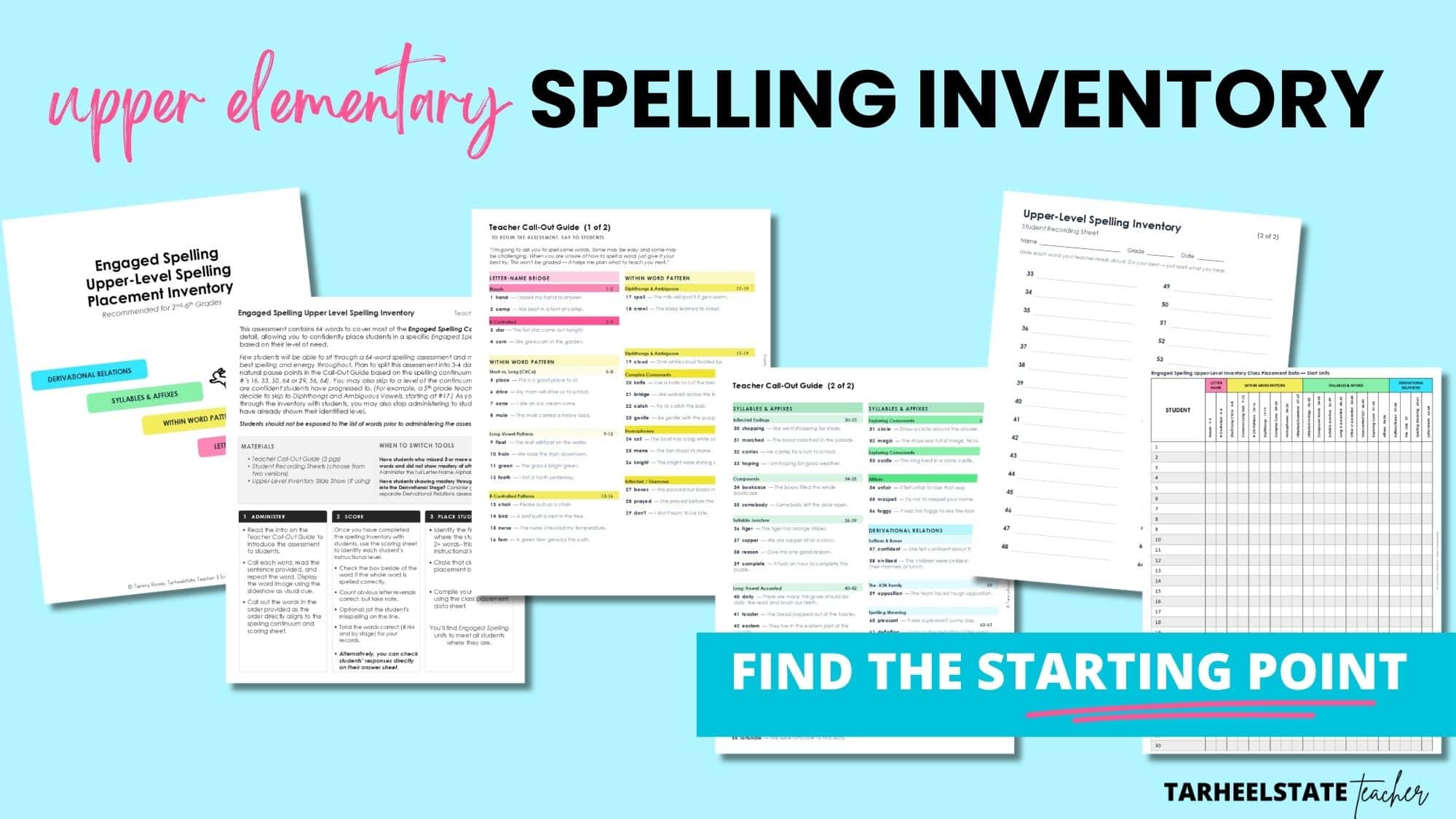
- Teacher directions with the steps for giving, scoring, and placing students
- The Engaged Spelling scope and sequence that notes the unit each test item comes from and the alignment to Words Their Way
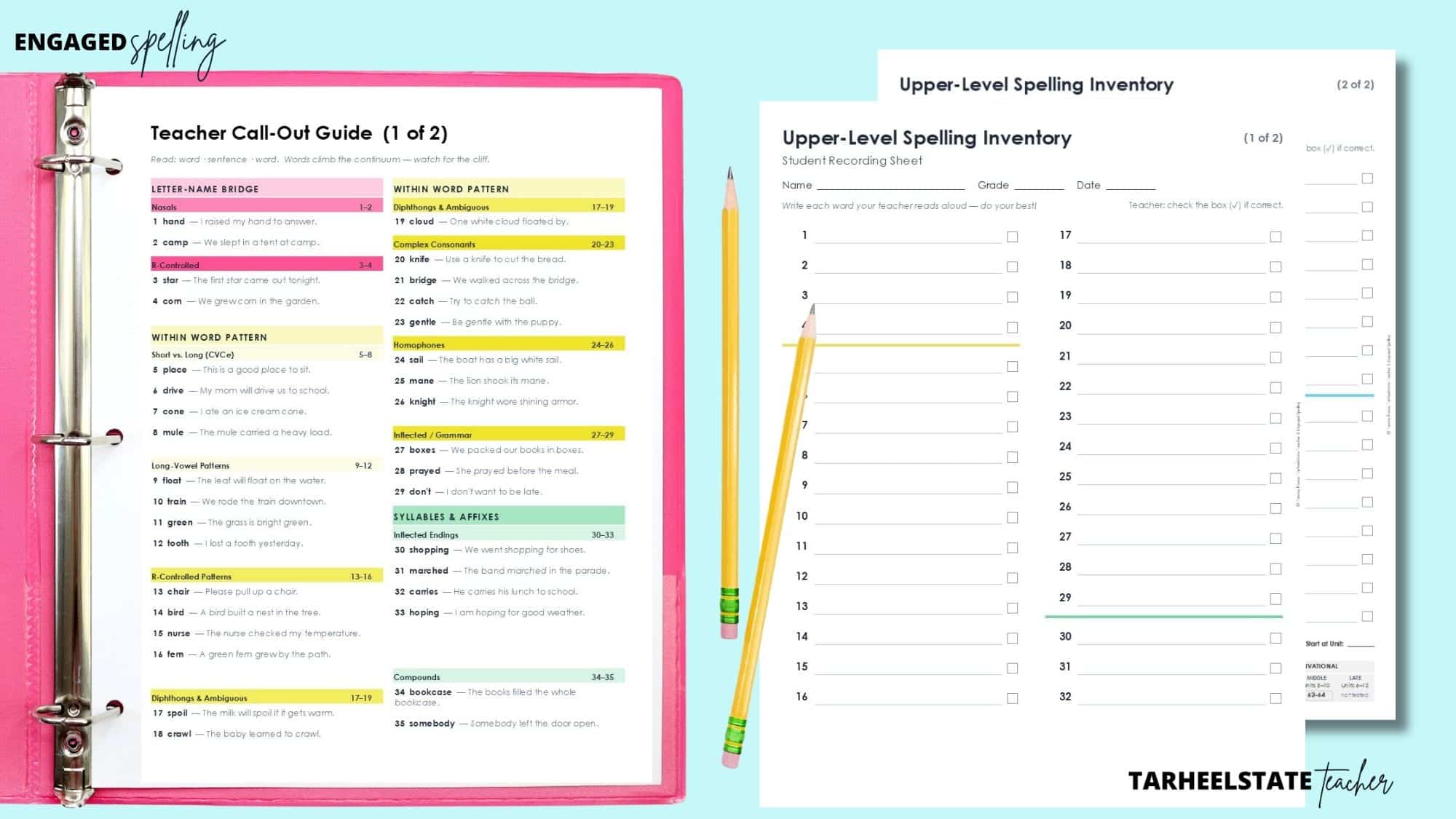
- A two-page Teacher Call-Out Guide with an introduction script and a sentence for each of the 64 words
- Student recording sheets in two versions: one with checkboxes beside each line so you can score right on the student’s page (my preference), and one without the checkboxes
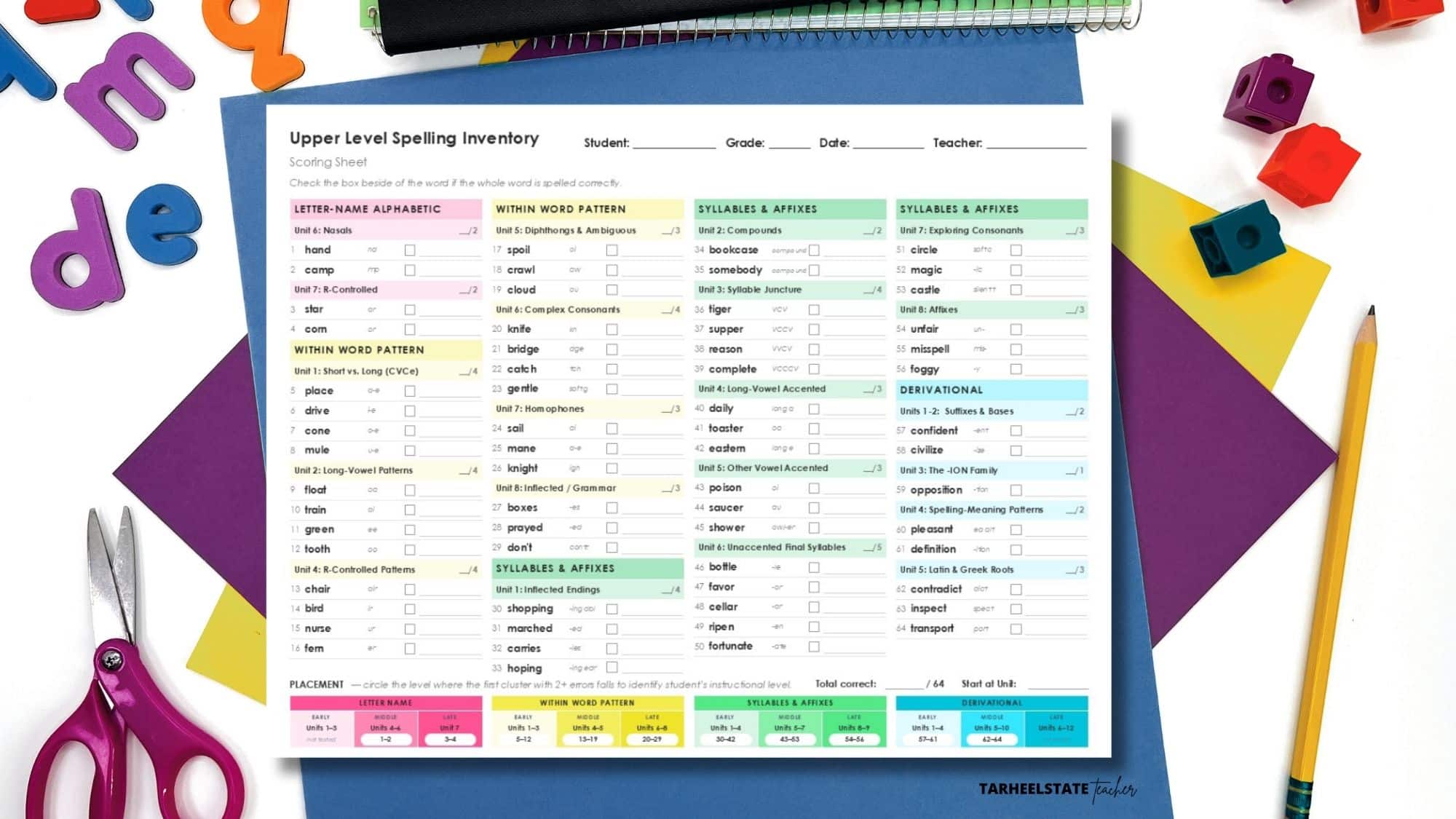
- An individual scoring sheet organized by stage and unit, with a placement band at the bottom
- A class placement data sheet for recording each student’s start unit to see your groups come together
- A Word Study/Spelling Groups planning page with room for six groups
- A PDF slideshow with a picture for each of the 64 words
HOW TO GIVE THE UPPER ELEMENTARY SPELLING INVENTORY
STEP 1: DECIDE WHERE YOUR CLASS SHOULD START
Most classes start with the first word. If you know your students have already mastered the earlier features, you can start at a later cluster. For example, a fifth grade teacher might start at word 17, the first word in the Diphthongs and Ambiguous Vowels cluster. You do want to make sure you don’t overshoot for any students who are working well below grade level, but you can always go back and assess a few students on the full list.
To allow a true assessment of students’ everyday spelling abilities, don’t share the words with them ahead of time.
STEP 2: PLAN FOR IT TO TAKE THREE DAYS
Very few students can spell 64 words in one sitting and keep their best spelling and energy the whole time. I spread the inventory across three days, and each day ends at a stage break:
- Day 1: words 1 through 29 (Letter Name-Alphabetic and Within Word Pattern)
- Day 2: words 30 through 56 (Syllables and Affixes)
- Day 3: words 57 through 64 (Derivational Relations)
The student recording sheets have colored lines after words 4, 29, and 56 that mark the stage breaks. By Day 3, some students will have already shown their instructional level, so you might only administer the Derivational Relations words for part of your class.
STEP 3: INTRODUCE THE INVENTORY TO STUDENTS
Use the script provided in the Teacher Call-Out guide to introduce the assessment to students:
“I’m going to ask you to spell some words. Some may be easy and some may be challenging. When you are unsure of how to spell a word, just give it your best try. This won’t be graded. It helps me plan what to teach you next.”
Letting students know the inventory isn’t graded helps them spell the way they normally would, giving you a more accurate snapshot of the spelling patterns they have or haven’t mastered.
STEP 4: CALL EACH WORD AND SHOW THE PICTURE
For each word, say the word, read the sentence from the call-out guide, and say the word again. Display the slide for that word so students see the picture while they spell.
Call the words in the order printed in the guide. The order follows the spelling continuum and matches the scoring sheet, so a student’s misses are grouped together by feature when you score.
HOW TO SCORE THE UPPER ELEMENTARY SPELLING INVENTORY
When you’ve finished assessing students, you’ll have this awesome pile of data! Use the scoring sheet to find each student’s instructional level.
- Check the box beside each word the student spelled completely correctly.
- Count obvious letter reversals as correct, and make a note of them.
- If you’d like more detail, write the student’s misspelling on the line beside the word.
- Total the words correct out of 64 and by stage.
If your students used the recording sheet with checkboxes, you can check off each correctly spelled word directly on the student’s page.
Once every student’s inventory is scored, you can use the scoring sheets to create your spelling groups. I share that process in How to Use Spelling Inventory Results to Form Spelling Groups.
GET THE FREE ENGAGED SPELLING UPPER-LEVEL SPELLING INVENTORY
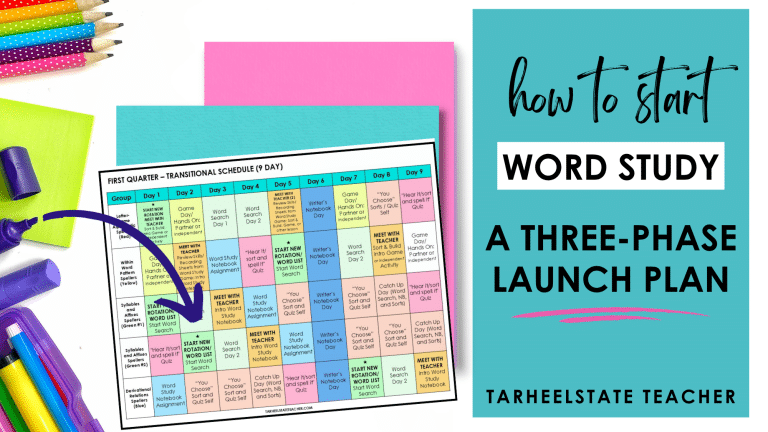
The free Engaged Spelling Upper Level Inventory includes the call-out guide, both versions of the student recording sheet, the scoring sheet, the class placement data sheet, the groups planning page, and the picture-cue slideshow. If you’re planning your first weeks of word study, the inventory is the first phase of my three-week word study launch plan.
Grab your free upper elementary inventory
Enter your email and I’ll send you directions for administering, your call-out guide, student recording sheets, charts for class data and small groups, and the kid-friendly call-out slides.
SUCCESS!!!
I'll be sending you an email right away with your copy of the Engaged Spelling Upper Level Inventory, your assessment slides, and the Teacher Call-Out & Scoring Guide!
If you do not see an email from Tarheelstate Teacher in the next 10 minutes, check your spam folder, then email me at tarheelstateteacher@gmail.com!
Once you know each group’s starting unit, you can plan their whole word study routine by printing the resources that match. For each unit, I’ve created a Discovery Word Searches, Unlock the List puzzles where students fill in missing letters to find the pattern, word study notebook activities, word sorting cards, and the printables for an easy-to-implement homework routine. I’ve recently organized these resources by individual unit, so you can get the unit each group is starting with OR grab all of the resources for that level.
After three short assessment sessions, I have a much clearer idea of where to start each student. If you want more info on how to form your spelling groups once you have scored your students’ assessments, check out the How to Use Spelling Inventory Results to Form Spelling Groups blog post, and reach out if you have questions!