I have been writing about word study and spelling routines on this blog for over a decade, and in all that time teachers ask some of the same questions. How much time should I allot for word study? How many groups? What am I supposed to DO when students are sitting at my table?
So I’m sharing my answers to the questions I get most often. Some of these questions get answered right here. Others get a quick answer plus a link to a helpful blog post where I’ve done a deep-dive into that specific topic.

Grab a coffee. Let’s talk about creating a spelling routine you actually look forward to. And don’t miss my opinion on having a spelling homework routine 👀!
1. WHAT ACTIVITIES DO YOU INCORPORATE IN YOUR WORD STUDY ROUTINE? I NEED TO GO BEYOND WORD SORTING!
While my first ever word study routine focused solely having students sort a list of words and record those sorts, I’ve grown far beyond the days of word sorts and buddy tests being my whole routine.
Over the years, I’ve added a variety of activities to my routine for various reasons related to the needs I observed in my students.
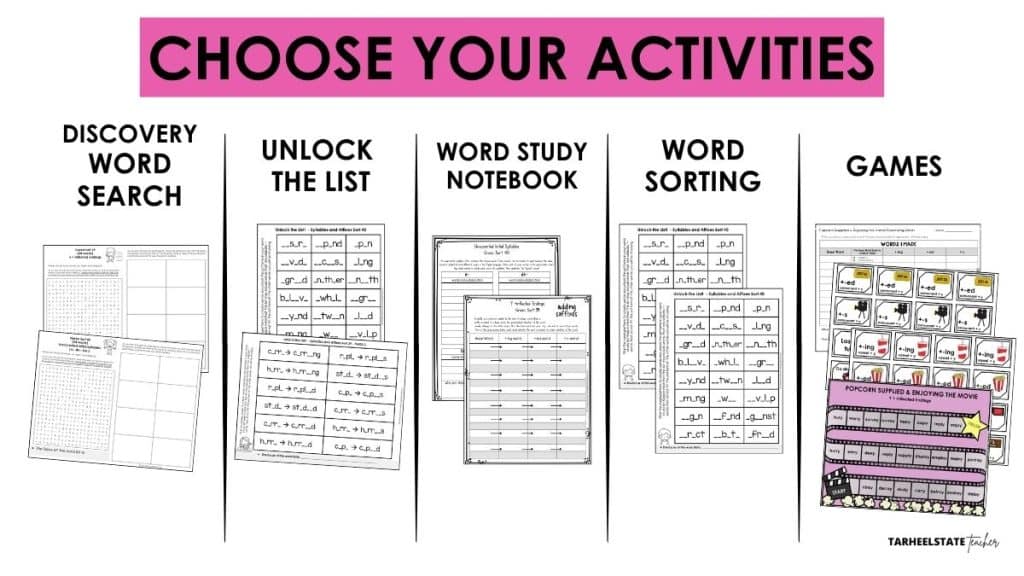
While sorting is an important part of a word study routine, it’s no longer the only thing on the menu. Here’s my buffet of other activities:
- Discovery word searches – students get a word search without the word list and have to “discover” the words hidden in the word search. Students sort the words into spelling-focused categories as they find them and are encouraged to figure out the pattern connecting the words they find.
- Unlock the List – a missing-letters, fill-in-the-blank activity. Students get their word list with vowels, consonants, word parts, or word patterns removed, and they work to “unlock” or “crack” the words. As they solve a few, they start seeing the same spelling pattern show up again and again in the words they haven’t cracked yet, which is exactly the thinking I want happening at the start of a new word list.
- Word study notebooks – students answer questions like “What do you notice about the sounds in these words?” and “How did the spelling change when that ending was added?” Word study notebook activities extend the thinking that students should be doing related to their word list.
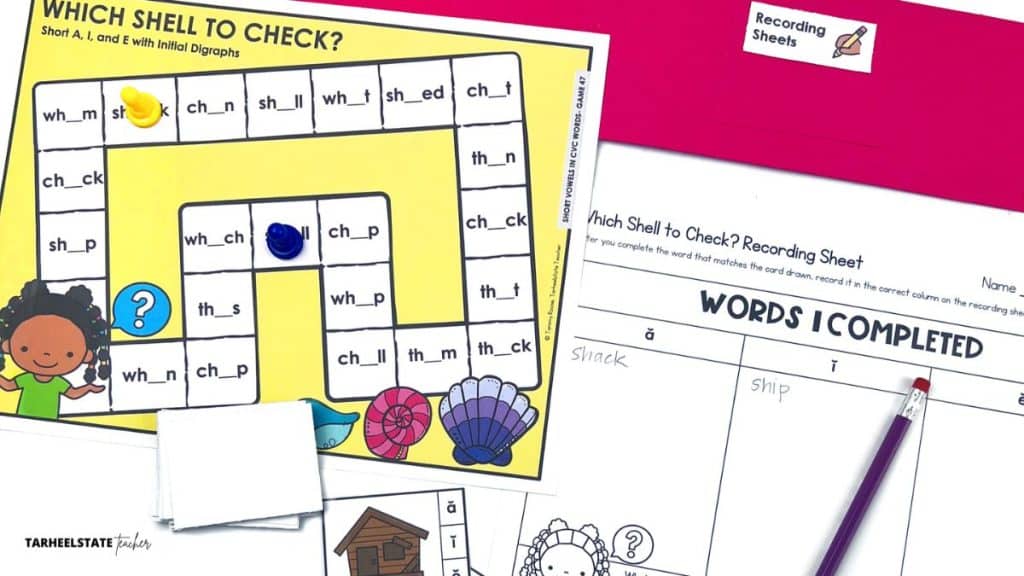
- Partner games and hands-on independent activities – these game centers include a recording sheet so that students stay focused while having fun and you can spot misconceptions. These are an important component for giving students multiple opportunities to practice their spelling words.
- Look, Say, Cover, Write, Check for self-quizzing – students take their word lists (from their word sort slips), place them in an upside down pile in front of themselves, flip over the first word, and
- Look at the word
- Say the word
- Cover the word (or flip it over)
- Write the word down
- Check it by looking at the word slip and comparing.
Students give themselves a check beside the word if it is spelled correctly. For any misspelled words, they record the correct spelling beside of their original try.
- Writer’s Notebook Day – students hunt through their own writing for misspelled words
- Catch Up Day plus a “You Choose” sorts choice board – if students need to finish up any activities from the previous days, this is a built in day for them to do so. If they are all caught up, they complete a variety of sorting activities from a sort choice board.
- Hear it/Sort and Spell It assessment – students test on their spelling words at the end of the cycle, sorting words into categories as they spell them.
You do not need to incorporate all of these activities right away. Choose the ones that will be most impactful for your students right now, train them to do those activities well, and add one or two more when the next quarter begins.
👉 You can find the full list of activities, with tips for each in 9 Activities for Your Word Study Routine.
2. WHAT'S THE DIFFERENCE BETWEEN WORD STUDY, WORD WORK, AND SPELLING?
These three types of word learning routines often get thrown around interchangeably in the upper elementary teaching world, but they have important differences in approach and purpose.
Spelling, in the traditional sense, is about learning to spell a given list of words correctly. Students practice writing words with activities like three times each, rainbow words, ABC order, etc., take a test (typically on Friday), and start a new list on Monday. The focus is memorization. Language Arts textbooks and literacy curriculums often include lists of spelling words and lessons for students to complete but they are often not based on developmental spelling levels or individual students’ needs.
Word work is mostly a lower elementary practice with a focus on phonics, sight words, and spelling—all critical for our earliest readers! Imagine students building words with magnetic letters, changing the beginning consonant in a word family (pat, mat, cat), and memorizing high frequency words. It often happens inside guided reading time.
Word study is where students are guided to discover and make generalizations about how words work. Instead of telling students the rule, you guide them to discovering it. For example, while sorting words that end in -ck and -ke, a student may notice that the -ke words say the long vowel sound while the -ck words say the short one. Word study aims to improve students’ ability to read words, spell words accurately, and understand the meaning of words, including how adding different word parts modify word meanings. “Studying” words is a foundational aspect of word study and moves away from a strict focus on memorizing how words are spelled.
Differentiation is often a big aspect that separates word study from a traditional spelling program. In a true word study routine, students are assessed with a spelling inventory and grouped by developmental level, so the patterns and concepts they’re working on are actually the patterns they’re ready for.
👉 I break all three practices down with examples in Word Study, Word Work, and Spelling: What’s the Difference?
3. WHERE DO I START? HOW DO I KNOW WHAT MY STUDENTS ACTUALLY NEED?
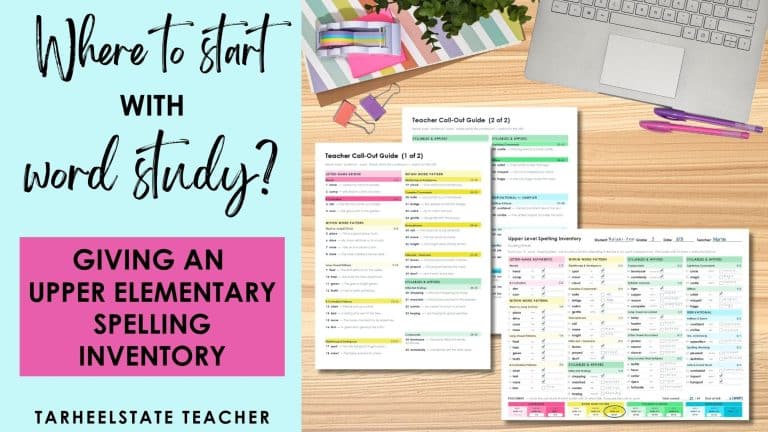
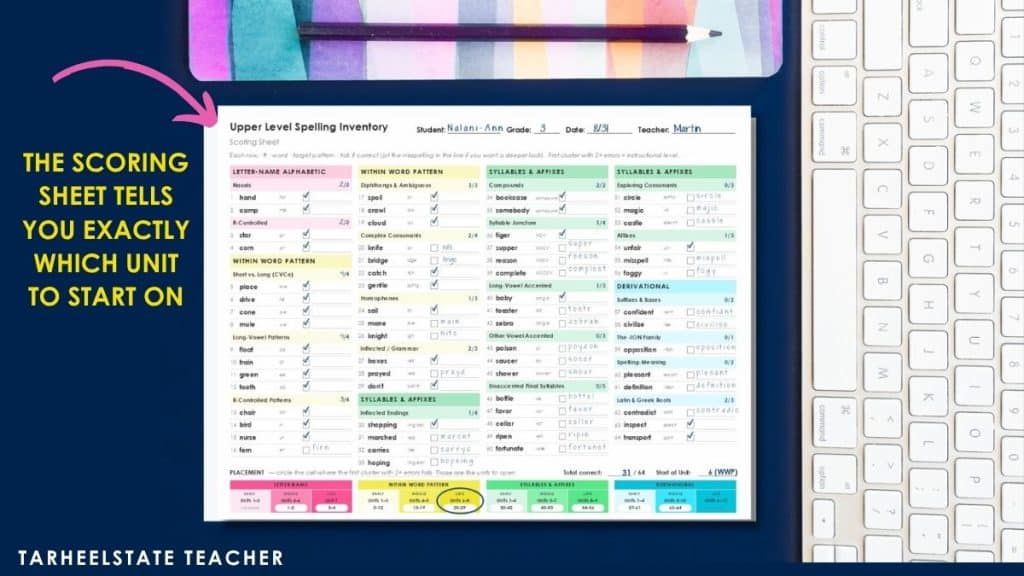
The best place to get started is with data. I use the Engaged Spelling Inventory, which builds on the Words Their Way inventory. It contains 64 words spanning from Later Letter Name-Alphabetic Stage through the Derivational Relations Stage. You can reduce the spelling inventory down to just the concepts you want to assess if desired!
Giving the spelling inventory by the end of the first quarter gives you real insight into what kind of spellers you have in your classroom. From their, you will be able to see if most of your class is in the same place, or if differentiated word lists and activities will benefit them most. Any upper elementary spelling inventory will work as long as it is based on a spelling continuum. A high-frequency words or DOLCH word list will not give the same results.
I highly recommend grabbing your own copy of the Engaged Spelling Inventory and putting it to use. It’s an amazing assessment, if I do say so myself! Plan for about three sessions of 15 to 20 minutes to get through it with your whole class.
Two important tips:
It’s important not to guess at students’ levels and not to assume reading levels = spelling ability. Guessing could put students working on patterns they mastered two years ago or patterns they can’t access yet, and a student’s reading level is not equal to their spelling development (Don’t we know this is true!).
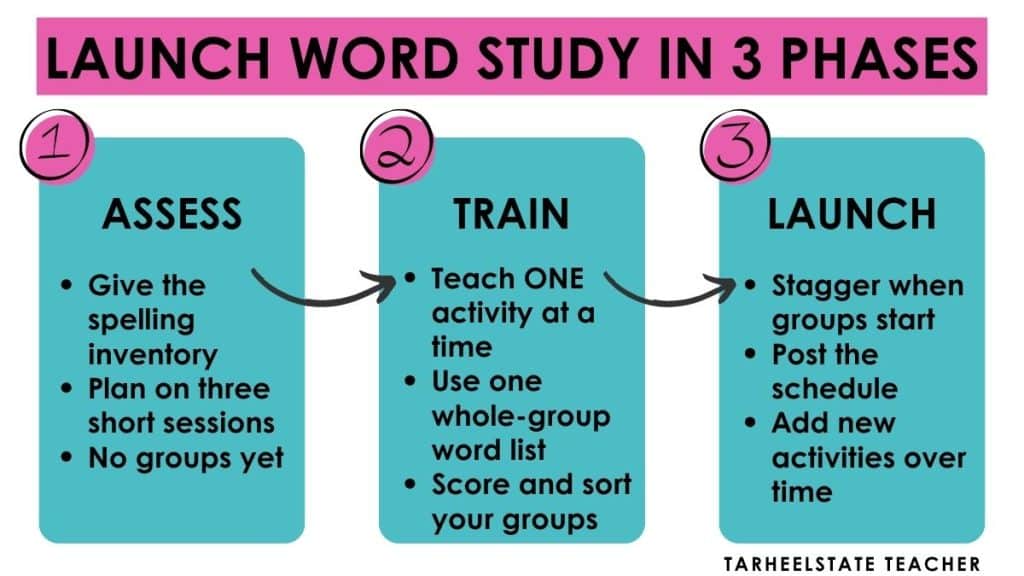
And, if you’re ready to get started, you don’t have to wait to start teaching until you’ve scored the assessments. Plan to give the inventory across three days, then score it while you train your class with a model word list. You’ll have time to get the assessments scored while simultaneously getting students into the routine.
When you score students’ inventories, cluster them into four to six. That’s really the most any of us can juggle well. And don’t agonize over the student who falls between two stages. Put them in the group they most closely match and move them later if needed.
Get the Free Word Study Launch Guide

Transform students’ spelling abilities with pattern-focused learning that actually sticks! Get your free word study launch guide and resources to implement a word study routine that frees you up for small-group magic ✨.
YIPPEE!! I'm so excited to share my plans with you!
I'll be sending you an email right away with your WORD STUDY LAUNCH GUIDE AND FREE ACTIVITIES 💕.
If you do not see an email from Tarheelstate Teacher in the next 10 minutes, check your spam folder, then email me at tarheelstateteacher@gmail.com!
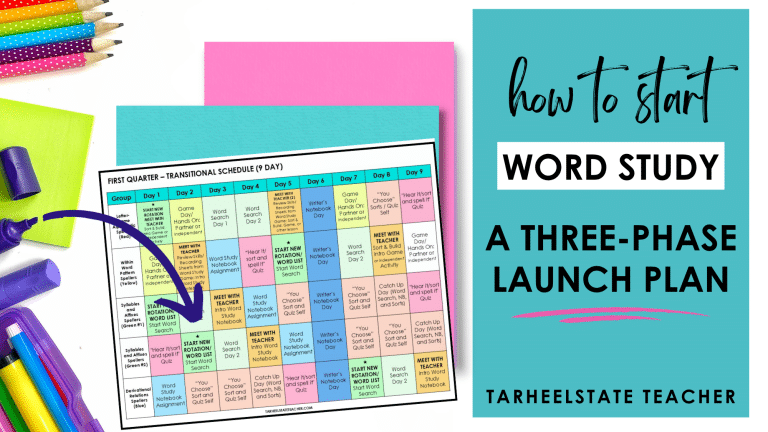
👉 The full first-three-weeks plan is in How to Start Word Study at the Beginning of the Year: A Three-Phase Launch Plan
4. HOW DO I TRAIN STUDENTS SO WORD STUDY RUNS WITHOUT ME HOVERING?
This is often an unspoken concern for teachers and after years of trial and error, I’ve found that the answer is to train students BEFORE adding in the differentiation. Planning a few weeks upfront to start slow can make all the difference!
After you give your spelling inventory (👈 Grab that free one!), spend the next couple of weeks going through the activities and routine using the same word list for your entire class. I recommend using a word list like homophones or commonly misspelled words that most everyone can benefit from reviewing. With everyone working on the same words and activities for a bit, you can teach your expectations.
Then, focus on teaching students how to complete one activity at a time. Model the activity in front of the whole class, let students try it while you watch, and only when it feels like they are confident there, move on to the next activity. Most of the activities I implement take about two days to teach well.
On the days you introduce each activity, teach the logistics that go with it: where materials will be stored, where students’ work goes, what “finished” looks like, and what to do if they have a question. I provide a ton of tips and the activities to get you started in my Word Study Launch Guide.
Get the Free Word Study Launch Guide
Transform students’ spelling abilities with pattern-focused learning that actually sticks! Get your free word study launch guide and resources to implement a word study routine that frees you up for small-group magic ✨.
YIPPEE!! I'm so excited to share my plans with you!
I'll be sending you an email right away with your WORD STUDY LAUNCH GUIDE AND FREE ACTIVITIES 💕.
If you do not see an email from Tarheelstate Teacher in the next 10 minutes, check your spam folder, then email me at tarheelstateteacher@gmail.com!
It can feel slow to get going, but I promise that every minute you spend on procedures now is a minute you get back ten times over once your rotation is running. Let’s not still be explaining where students’ word slips go in November!
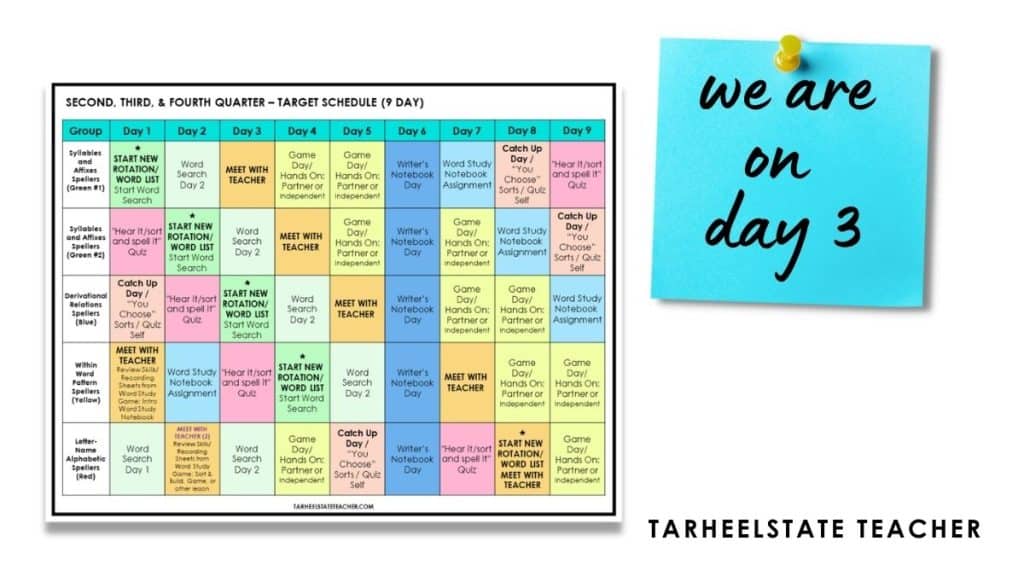
Once students have shown you they can handle the expectations of each activity, teach them how your rotation board works, and launch your groups. I recommend a staggered schedule where group one starts their cycle on the first day, group two the next, and so on. If you kick off each group on a different day, you’ll get to ease everyone into their activities and you’ll have different groups doing different things on different days–which is magical because it frees YOU up for Meet with the Teacher time. After each group has their first day, they’ll all be continuously in the cycle.
We will talk more about this staggered schedule in the next question!
👉 I walk through all three phases, day by day, in How to Start Word Study at the Beginning of the Year: A Three-Phase Launch Plan
5. DOES MY SPELLING BLOCK HAVE TO BE STRUCTURED FOR MONDAY THROUGH FRIDAY?
No, no, and NO! And realizing this was one of the best discoveries I have made in my teaching career.
Most of us were trained to plan our spelling block as “on Monday we do this, on Tuesday we do this.” Then reality shows up in the form of a two-day week for Thanksgiving, an assembly, a fire drill, and a snow day. Suddenly you have skipped three activities and you’re not implementing word study with any fidelity at all. Worse, students lose buy-in for a routine that never actually happens the way you said it would.
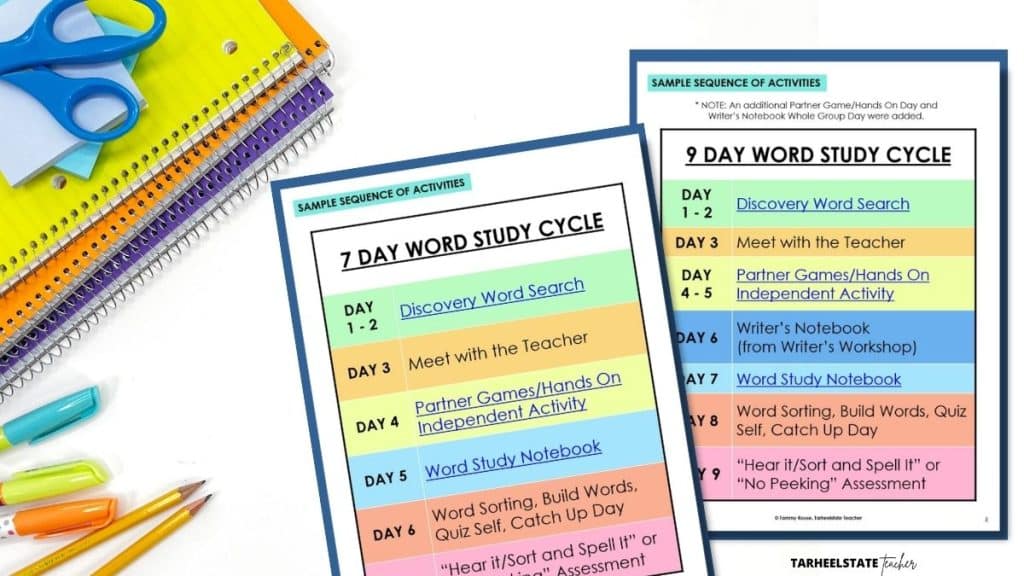
Instead, think of your activities as a CYCLE that students move through, regardless of what day of the week it happens to be. My cycle runs 7, 8, or 9 days, depending on what activities I incorporate. This means that one word list takes about two weeks but students don’t skip anything because of an interruption to our schedule. When your word study block gets thrown off by something, students just pick up at the point in the cycle where they left off the next time you have word study.
Yes, it takes longer to get through one word list this way. But my students and I are far more invested in our spelling routine, because we know that ALL of the activities are going to happen for that list. Nothing gets skipped just because Tuesday had a schedule conflict.
My students went from tolerating word study to begging for it, and this schedule change is a big part of why.
👉 My full cycle, activity by activity, is in My Words Their Way Word Study Routine: 7, 8, or 9 Day Schedule
6. HOW LONG SHOULD WORD STUDY TAKE, AND HOW DO I FIT IT IN?
You should plan for a word study block of fifteen to twenty-five minutes.
I know that sounds short, especially when you look at a list of spelling activities and wonder how any of them fit, but it’s enough to make a real difference in your students’ spelling. Two things make it work.
First, students do one activity per word study block. My spelling block is short, so students “rotate” to the next activity on the following day or session instead of moving between stations during a single block.
Second, you only ever put yourself on the schedule with ONE group per spelling block. Once everyone is settled into their activity for the day, you can give that group your full attention. It doesn’t sound like much, but realizing that I could design a schedule where my full focus could be on ONE small group was a real aha. (If needed, you could double up with your two highest groups sharing you on a day towards the end of the cycle; we can often move back and forth between the higher groups by training them to lead their own discussion. Considering this could give you flexibility to meet with your lowest group a second time. It really all depends on the number of groups you have and the number of activities you implement.)
👉 Go deep on how rotations work in a short word study block in Teaching Word Study Block With Stations, Rotations, or Centers
7. HOW MANY SPELLING GROUPS SHOULD I HAVE, AND WHAT IS EVERYONE ELSE DOING?
I’ve found four to six spelling groups to be manageable with five being the ideal sweetspot. Most of my upper elementary classes shake out into five groups spanning Letter Name-Alphabetic through Derivational Relations. Any more than 6 groups and you may go a little nuts and not feel like you are meeting anyone’s needs well.
As for what students are doing while you meet with a small group, they’re working on their own assignment for that day, and they know what it is without asking you. Here’s how:
Stagger your spelling rotations so each group starts its cycle on a different day. When each group’s “Day 1” is on a different day, their Meet with the Teacher days naturally happen on different days too. If you’re incorporating technology or game centers, groups use those materials on different days, keeping traffic jams to a minimum and maximizing your resources.
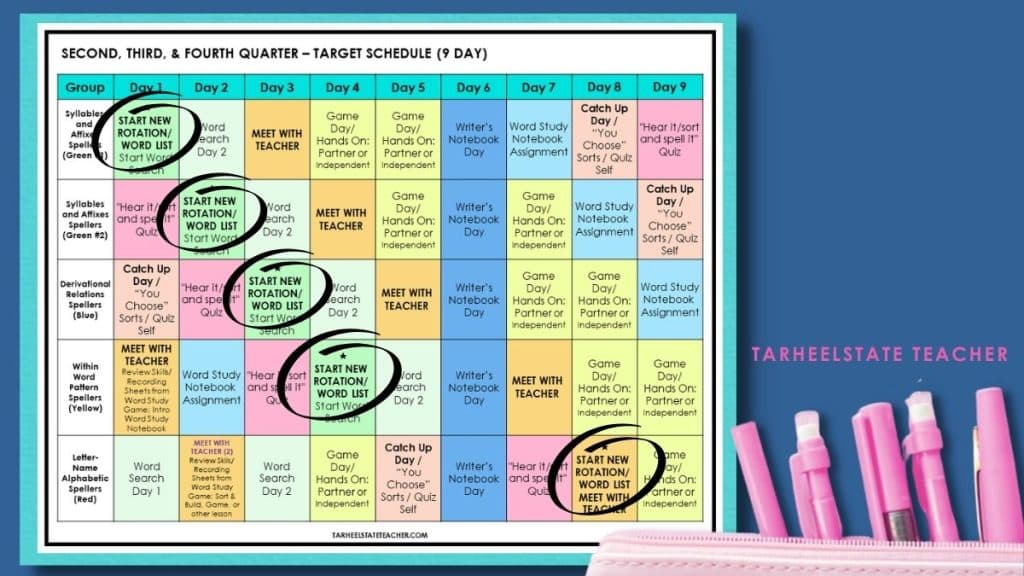
Put Meet with the Teacher on the schedule first. Once those days are locked in, plug in the other activities in the order you want students to move through them. I make sure students get two word search days before they meet with me, so they have something to bring to the table. Assessment always comes at the end of a group’s rotation, but a flexible activity like a tech day can go anywhere in the sequence. During your initial launch, one additional group starts each day and everyone who hasn’t started yet reads independently until their turn comes.
Build in a whole-group day or two for an activity that you feel is important. Not every day of your word study block has to be five groups doing five different things. I often add a vocabulary day (perfect for when we are studying our science vocabulary for state testing) and a writer’s notebook day in the cycle. On these days, the entire class works on the same task at the same time, offering a breather for everyone, including you.
Post the rotation schedule in the room. If you can print it larger than 8.5 x 11, great, but I always print my schedule on regular sized paper and students refer to it just fine. You can put a student in charge of moving the “We are on day ⬇️” sticky note each morning. When your word study block begins, students simply check the schedule for their group and get to work.
Train students on what to do when they arrive at your small group table. Students who sit down at your table and wait for directions can lose three minutes of a fifteen minute meeting. Multiply that across five groups and a school year and you have lost hours of small group instruction to kiddos sitting politely, waiting on you. You can easily have students begin a beneficial activity while waiting for other group mates to get settled and you to get to the table.
- Students can continue working on Unlock the List or their Word Search.
- Students can share and compare their work with Unlock the list or the words they found in their word search.
- Students can begin sorting their words.
Whatever task you think is best, be sure to make those expectations clear to students so that when they sit down, they are working. Your expectations can vary depending on the group.
👉 I map out the whole staggered schedule (red arrows and all) in my blog post titled One Teacher’s Word Study Schedule.
And, want to build your own schedule? Grab your own template to make a staggered word study schedule and see more examples.
8. WHAT DO I DO WITH THE STUDENTS WHO ARE WAY BELOW OR WAY ABOVE EVERYONE ELSE?
Even as a 4th and 5th grade teacher, I always had a small group of students still working on short and long vowels AND a group of Derivational Relations spellers who could already spell almost anything. These students need different things from us, and the schedule is where we build that in.
For your lowest spellers, schedule their Meet with the Teacher day BEFORE their word search day. Everyone else discovers their words through the word search first, but this group meets with me on day one of their rotation. We sort words together, which exposes them to their list before they go hunting for it, and I introduce their hands-on or partner game so they can play it independently. During our meeting I hand out whiteboards and fire off words from their current list and previous lists, focusing on immediate feedback. If a student misses a word, I throw another word with that same pattern at them later in the meeting. I also pull in compound words that follow their patterns (hotdog, pancake, birthday), which lets them practice double the words and feel like they’re working with words as big as everyone else’s. That matters more than you’d think for a group that can get stigmatized.
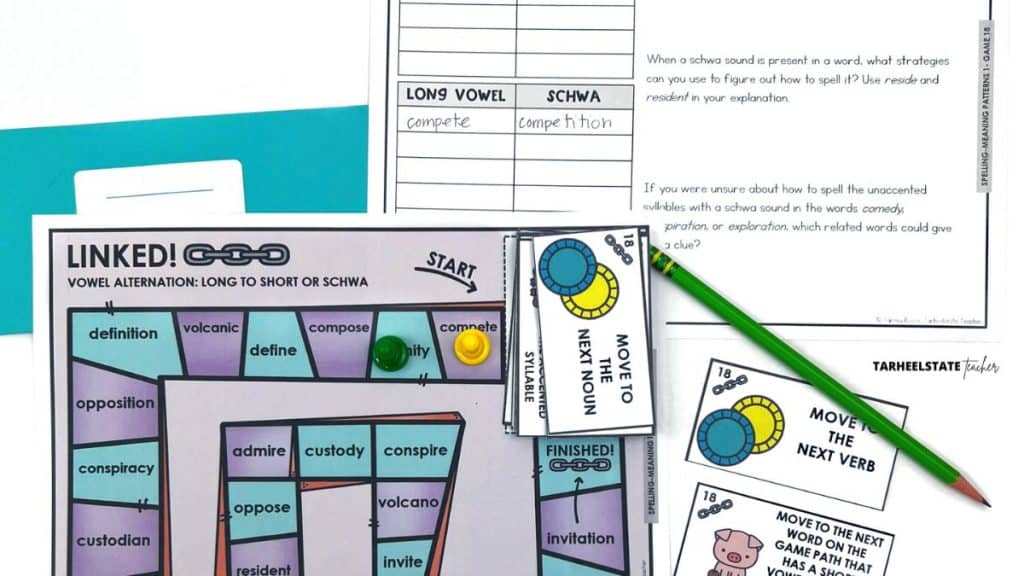
For your highest spellers, spelling accuracy isn’t really the challenge anymore. Their work shifts toward word meaning, etymology, and connecting the words they’re studying to other words in the language. I have this group do Frayer-style analysis of a root, generate other words that contain it, and dig into where a word came from. I also stopped testing them on words they had already proven they could spell.
The important thing about your word study groups is that you get to DIFFERENTIATE WITHOUT STIGMA. A staggered schedule makes differentiated spelling possible without singling anyone out. Because each group is working on different things on a given day, you can modify what the highest and lowest groups do without it being obvious to anyone that their assignments look different.
👉 Learn more about modifications in How to Modify and Differentiate Your Word Study Routine
9. WHAT AM I ACTUALLY SUPPOSED TO DO DURING SMALL GROUP TIME?
Small groups used to stress me out a little. There’s a bit of pressure that comes with knowing you’ll be meeting with a group you haven’t quite prepared for. I don’t want you floundering on how to use your time, so let’s have a few useful routines we can use for any group.
First, start with an opening routine that requires nothing from you. My students arrive with their word study notebooks and know to turn to their word search and keep hunting until I’m ready. Then I ask for volunteers to share the words they found, and as they share, I start recording a sort on chart paper and ask the group to help me place each new word.
From there, what you do depends on the stage the group is in. Your Within Word Pattern group needs to generate long vowel words in a dozen different ways. Your Syllables and Affixes group may need to discover the doubling and dropping rules through open sorts rather than being told. Your Derivational Relations group probably needs to discuss how the meaning of the Latin root helps us infer the meaning of a word.
One move that works at every stage: when a student misplaces a word in a sort, don’t correct it. Ask them to read all the words in that category out loud and then ask whether they all seem to fit. Most of the time you won’t even need the second question.
👉 I wrote a post for each stage with specific activities: Letter Name-Alphabetic, Within Word Pattern, Syllables and Affixes, and Derivational Relations
10. SHOULD STUDENTS HAVE SPELLING HOMEWORK?
Yes! I’m putting a stake in the ground on this one.
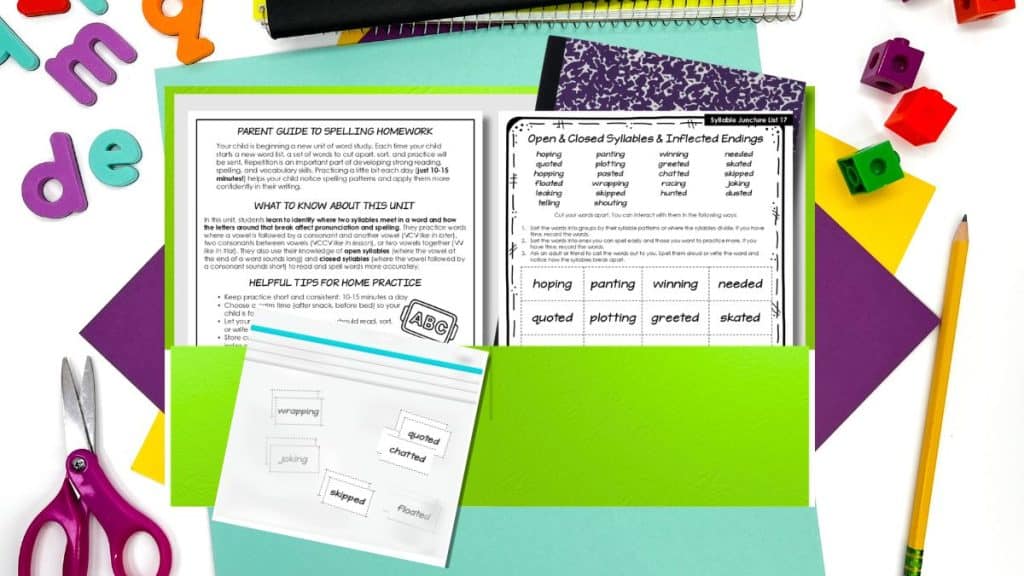
Spelling is one of the few things parents can genuinely help with. They can call words out, they can sort with their kid at the kitchen table, they can see growth happen. Most families want that connection and are glad to support what students are working on at school.
But, there are two considerations that will make your spelling homework more effective.
It needs to match the student’s level. A one-size-fits-all list sent home can send some families in a panic and cause you to lose some trust with others. If you are going to send home spelling homework, it really should be differentiated to the needs of the child, otherwise it may be too hard OR become busy work for students above grade-level. I don’t have to keep telling you that I’m a fan of differentiated word study and spelling instruction, so the homework should match that practice.
Wait until your in-class routine is humming. Homework is not a launch-week activity. Get your rotation running smoothly first, then bring families in. By that point students know their lists and their patterns, so the take-home practice is reinforcement rather than one more new thing.
Ten to fifteen minutes a few nights a week is plenty.
 Find my spelling homework routine for every group’s need in my Shopify store.
More on building a homework routine that runs itself in How to Make Spelling Homework Easy, Consistent, and Stress-Free
Still have a question?
Word study is one of my favorite things to talk about, and if you’re wondering about something, I promise another teacher is wondering, too.
And if you’re starting from the beginning, the free Word Study Launch Guide gives you everything you need to train your routine before even have your assessments graded. Because your whole class works on the same list during training, you can print and prep for your first sort before knowing what groups students will be in.
Inside of the Launch Guide, you’ll get all of the resources for a model word list (I chose Within Word Pattern Sort 52, Long I and O homophones, which is a low-risk list that lets you focus on your routines instead of the content.)
Get all of this today:
- a Discovery Word Search and an Unlock the List page, so you can model either entry activity
- Tips and directions for word sorting, plus a sample sort
- a partner game and an independent activity
- The “You Choose” sorts choice board plus direction posters for nine types of sorts
- a “How to Quiz Yourself” poster for Look, Say, Cover, Write, Check
- a Meet with the Teacher expectations poster, with a blank version if you’d rather write your own
- a suggested activity list, a sample schedule, and my procedures for each routine
Print it, get ready to model the activities you like, and train your students to be ready for your engaging, impactful staggered word study routine!
Get the Free Word Study Launch Guide
Transform students’ spelling abilities with pattern-focused learning that actually sticks! Get your free word study launch guide and resources to implement a word study routine that frees you up for small-group magic ✨.
YIPPEE!! I'm so excited to share my plans with you!
I'll be sending you an email right away with your WORD STUDY LAUNCH GUIDE AND FREE ACTIVITIES 💕.
If you do not see an email from Tarheelstate Teacher in the next 10 minutes, check your spam folder, then email me at tarheelstateteacher@gmail.com!