4th and 5th grade teachers, are you still trying to decide which chapter book to use for your first read aloud? If you’re anything like me, this decision tends to come down to the wire, so I want to share some of my all-time favorite books to read as the very first chapter book a new class and I share together.
At the start of every year, I spend time mulling over which chapter book will be my first read aloud. It’s a big commitment and I want to make sure it’s the right one. The good news is I have some breathing room to decide, because during the first few weeks of school I read a ton of picture books. (I’ve also put together a list of my favorite back to school picture books on Amazon.)
I’m a firm believer in reading aloud to my students, and we always have a chapter book going. This line from Donalyn Miller’s Reading in the Wild has stuck with me ever since I first read it:
“Every school year, I regret not reading aloud MORE to my students.”
I try not to let myself believe, even for a second, that we “should be doing something more” during read aloud or independent reading time. Reading widely and loving it is the goal of reading instruction, not getting through worksheets.
Because I read so many picture books early on, I usually have one to two weeks before I’m ready to invest our classroom time in a chapter book. Many of the titles below share similar themes, so any of them fits my early-year goals: reviewing reading skills, strengthening our classroom community, teaching inference, and analyzing characters more closely. Whichever I choose, I know it will serve those goals well.
MY FAVORITE FIRST CHAPTER BOOK READ ALOUDS
Here are the books I come back to again and again for that all-important first read aloud (in no particular order):
- Wonder by R.J. Palacio
- Stargirl by Jerry Spinelli
- Firegirl by Tony Abbott
- The Tiger Rising by Kate DiCamillo
- Wings by Bill Brittain
- Just Juice by Karen Hesse
- Pictures of Hollis Woods by Patricia Reilly Giff
A quick note before the reviews: Wonder now tops my list as the ultimate classroom read aloud and community-building experience. I cried at the end and rooted for Auggie the whole way through, it’s literary perfection for the start of a school year.
Wonder by R.J. Palacio
I read Wonder in just a few days, and I am a SLOW reader, so that tells you something. Auggie, the main character, was born with a craniofacial difference: droopy eyes, a cleft palate, and a partially formed jaw. He’s used to people looking at him and quickly looking away. His parents homeschooled him until 5th grade, and the book chronicles his first year in a middle school setting. As you’d expect, he encounters bullies, fake friendships, and hurt feelings, but also true friendship, triumph, and finally, acceptance.
I had to fight off the urge to sob the entire time I was reading. It’s a wonderful way to start the year, bring a group of students together, and teach compassion. The book challenges every reader, young and old, to notice how superficially we move through the world and how critical we are of our own looks. I especially love that it’s written from multiple perspectives and most chapters are bite-sized, which makes it feel like we’re moving fast.
Stargirl by Jerry Spinelli
When I was student teaching, I picked up a copy of Stargirl and Jerry Spinelli became my favorite children’s author. This man understands childhood. Many students are surprised to find the book has a male narrator, Leo.
Stargirl usually shows up in my 5th grade curriculum as a book club, but one year I used it as a read aloud to target the theme of conformity. Mica Area High School is a “hotbed of conformity”, even the unpopular kids follow along, until Stargirl, a homeschooled, march-to-the-beat-of-her-own-drum girl, arrives. Leo eventually falls for her, then realizes he’s being ostracized because of their friendship. The central conflict is the choice Leo feels he must make: rejoin the world of conformity and be accepted, or keep his friendship with Stargirl. Regret, being caught between a rock and a hard place, and accepting others for their uniqueness are huge themes here. I underline and highlight as I read, and this one is full of beautiful language.
Firegirl by Tony Abbott
I’ve used Firegirl once as a read aloud and many times as a book club book. If you want a read aloud that hits some of the same themes as Stargirl and Wonder but is shorter and less complex, this is the one.
Jessica comes to Tom’s school mid-year while receiving burn treatments at a local hospital after a gas tank exploded while her mom was pumping gas. The classroom environment shifts completely when she joins. She can’t attend all the time because of her treatments, and when she does, no one speaks to her or wants to touch her. Mid-book, Tom begins a friendship with Jessica when his teacher asks him to drop off her schoolwork. After she returns home, Tom is left with real regret about not reaching out sooner. The book opens the door to teaching compassion and regret, and to discussing how to be a leader rather than a bystander. (It pairs beautifully with the picture book Each Kindness.)
The Tiger Rising by Kate DiCamillo
This was my second read aloud last year and has previously been my very first. I was introduced to it when my school began using the Lucy Calkins Reading Units of Study.
The Tiger Rising is captivating. I read it in about an hour and bawled at the end. It has so much to teach us about dealing with our demons. Here’s the publisher’s description, which doesn’t quite do it justice: twelve-year-old Rob Horton discovers a caged tiger in the Florida woods on the same day he meets Sistine Bailey, a girl who shows her feelings as readily as Rob hides his. As they learn to trust each other, they prove that some things, like memories and heartache and tigers, can’t be locked up forever.
I taught students to walk in the characters’ shoes, have compassion, and deal with their own “suitcase” of emotions. This book is how I fell in love with teaching symbolism to 4th and 5th graders, they are absolutely not too young for it, and the authors they read are using it. To me, the tiger is the least important thing in the book, but it keeps kids wanting more and serves as a symbol of Rob and Sistine’s emotional imprisonment. Sistine’s father is out of the picture and Rob’s mother has recently died. Rob’s father moved them away to escape the pain, never talks about her, and struggles to show love. Rob stuffs his feelings inside a metaphorical suitcase, while Sistine lets hers explode. Put this one on your “to read” list if it isn’t already.
Wings by Bill Brittain
I’ve used Wings with 4th graders a few times. I go back and forth on it, the writing isn’t Jerry-Spinelli-amazing, but the storyline keeps students engaged. It’s set in the Appalachian Mountains of NC, which makes it a nice tie-in to our social studies curriculum.
Here’s the premise: no one can explain why Ian has sprouted wings, or adjust to their huge batlike appearance. With family and friends hostile about his situation, only Anita Pickens gives Ian the will to use his wings and survive his ultimate decision to have them removed. Yes, you read that right, Ian is sprouting wings, and at that point I have kids on the edge of their seats. Ian’s parents are so self-involved that my students love and hate watching their relationship with him. His wings read as a cry for help in a family where he’s the last priority. An enjoyable read, and it’s here because I’ve used it as a first chapter book at least twice.
Just Juice by Karen Hesse
The first year I taught “Building a Reading Life,” one of the Lucy Calkins units, I used Just Juice. Juice is a tomboy who lives in the mountains with her mom, pa, two older sisters, and a baby on the way. She’d rather run around outside than sit behind a school desk, and the truancy officer has visited the house more than once. Juice has a secret that students piece together along the way: she can’t read, and it makes her not want to go to school. She was held back the year before and often mentions how her classmates moved up a grade without her.
This book is perfect for teaching an appreciation for the ability to read, helping struggling students see they’re not alone, and reinforcing a growth mindset.
Pictures of Hollis Woods by Patricia Reilly Giff
This one deals with foster children and abandonment. Hollis Woods is always running from something, and she may have run from the family that truly loved her. What makes the book special is the “pictures”, italicized sections before each chapter that hold Hollis’s memories. I use it to teach students that readers learn to “coach” their own reading lives, and it’s perfect for the transition from 4th to 5th grade.
Rather than tell students what the italicized sections are, I read a bit and try to get them to figure it out. Most realize the snippets are flashbacks, though it may take some prompting to connect that to why the book is called Pictures of Hollis Woods. Hollis is a character who wants to be loved, whom we love, and whom we root for the whole way through.
WHY THESE BOOKS?
From the looks of this list, it’s safe to say I gravitate toward read alouds that teach students to treat one another with tolerance and compassion, to face life, and to become better people. I believe each of these books is the kind that sticks with readers forever.
MORE READ ALOUD IDEAS
If you’re hunting for more titles, there’s a long-running collection of teacher-favorite chapter books for grades 3-8 over at Mr. Hughes’ blog, An Educator’s Life. It’s organized by grade level, so it’s easy to browse for something new. (It’s an older round-up, so think of it as an archive of recommendations rather than an active list.)
This post focused on the very first chapter books to read aloud. I’ve also written about other favorite read alouds to share as the year goes on.
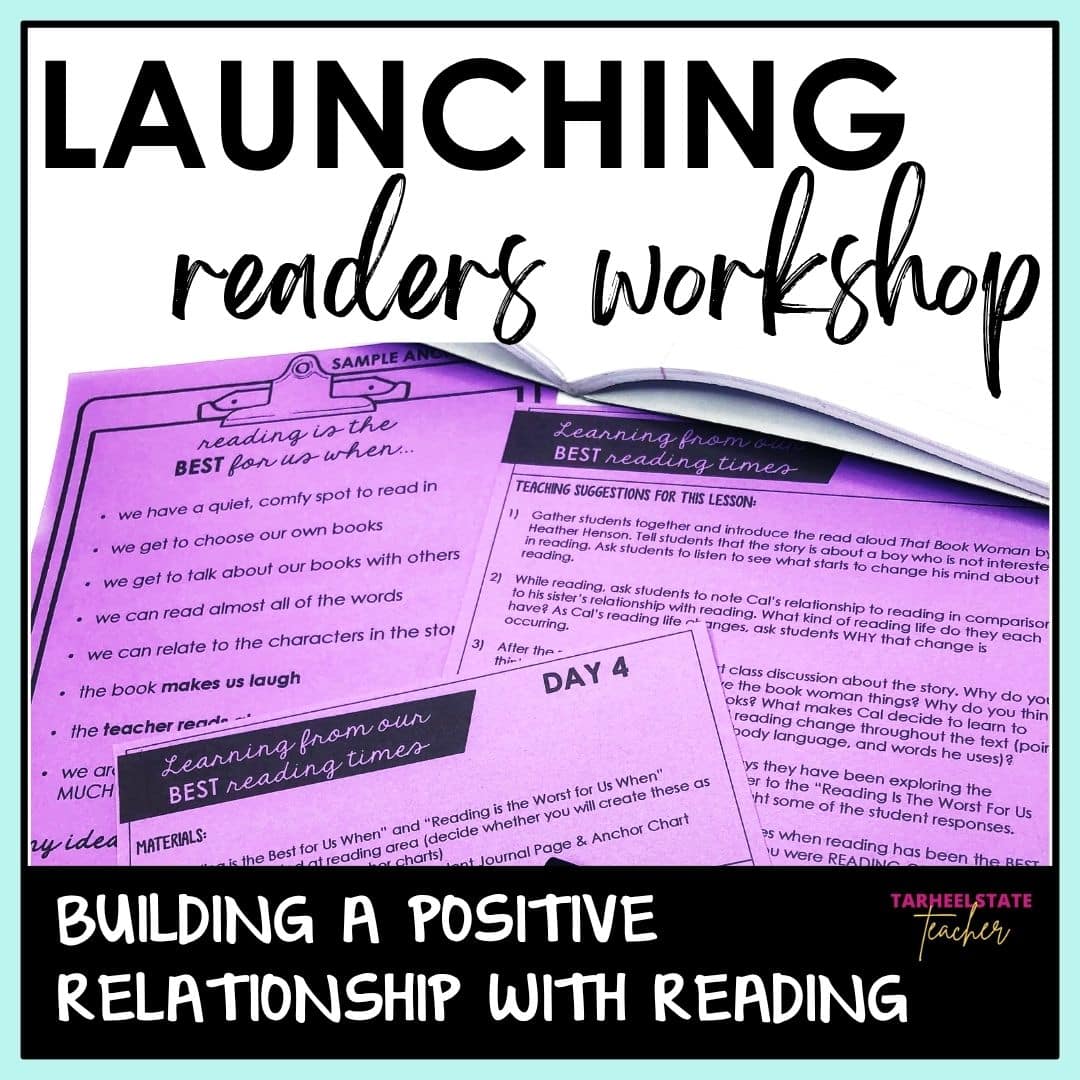
 Want to set the tone for a year of readers? These read alouds build community and compassion, but turning every student into a reader takes a plan. Grab the first lesson from my Building a Reading Life unit free, it’s how I begin the year.

Let’s help students build a reading life! I’ll send you the “Reading is the WORST for Us When…” minilesson notes, anchor charts and student journal pages for the first lesson! Just subscribe below for your plans to help students build an amazing reading life this year!