If you’ve ever heard a student mutter, “I’m so bad at this,” or “I can’t do it,” then you’ve seen the power of self-talk at work—just not the kind we want to encourage. Helping our upper elementary students practice positive self-talk can make a big difference in how they approach challenges, build confidence, and stay motivated even when things get tough.
In this post, you’ll find positive self-talk examples, activities, and reflection ideas you can use right away to help students develop intrinsic motivation in the classroom—and enjoy the learning process more as a result. For more ideas on how to build intrinsic motivation in the classroom, click here.

WHAT IS POSITIVE SELF-TALK?
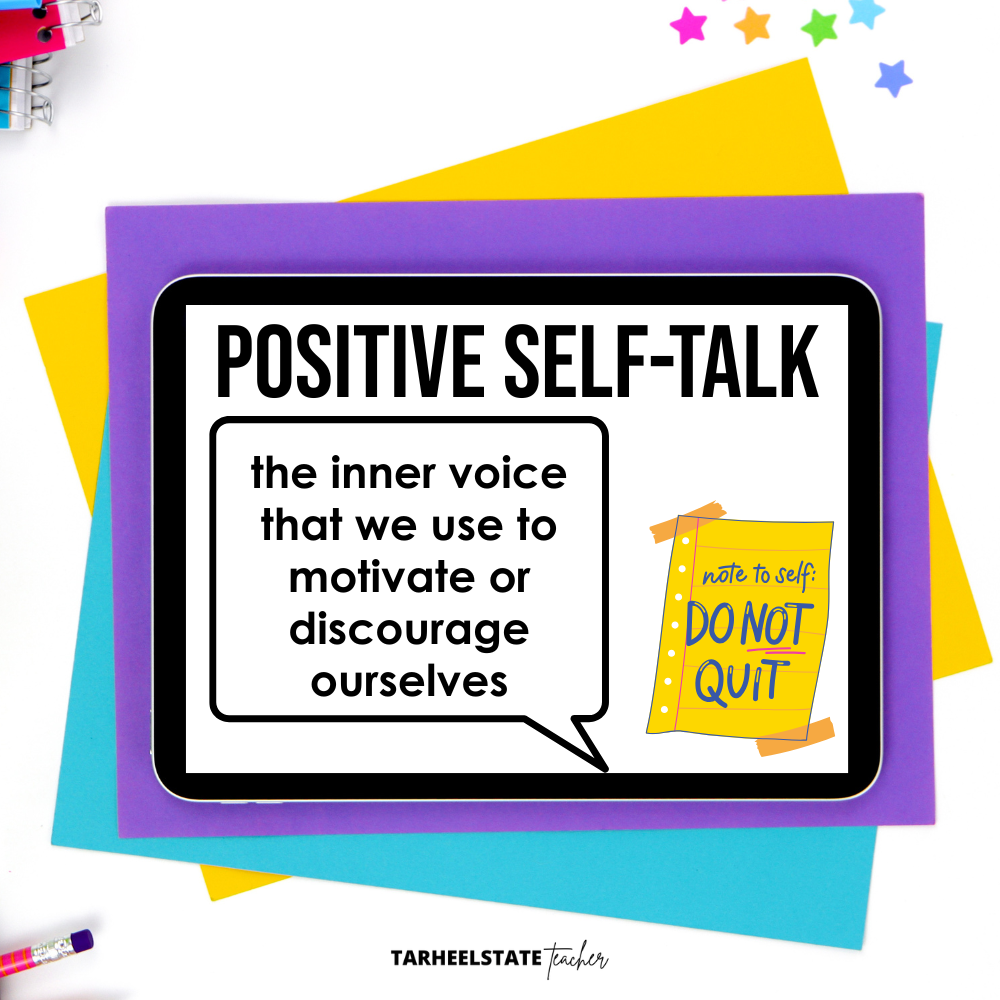
Positive self-talk is the inner dialogue that encourages, reassures, and supports us when we’re facing challenges. It’s the little voice that says, “You’ve got this,” or “Just try one more time,” when a student is stuck on a math problem or nervous before a presentation.
Just like negative self-talk can increase anxiety or avoidance, positive self-talk helps students stay calm, focused, and engaged—which leads to better performance and a greater sense of intrinsic motivation.
WHY POSITIVE SELF-TALK MATTERS FOR MOTIVATION IN THE CLASSROOM
Research shows that intrinsic motivation—the drive to do something because it’s personally rewarding—plays a huge role in student learning. When students feel confident and capable, they’re more likely to take ownership of their work, persist through setbacks, and find joy in the learning process.
Teaching students to recognize and replace negative thoughts with positive self-talk statements is a powerful way to support this mindset. I also like weaving in mindfulness activities for the classroom to help students practice noticing their thoughts without judgment—an important step toward building confidence and intrinsic motivation.
POSITIVE SELF-TALK EXAMPLES FOR STUDENTS
Here are a few simple phrases you can introduce to your class:
- “I can try again.”
- “I learn from my mistakes.”
- “I don’t know this yet, but I will.”
- “I’ve done hard things before—I can do this too.”
- “One step at a time.”
These phrases might sound small, but they can have a huge impact when students are facing a challenge or feeling stuck.
3 READY-TO-USE POSITIVE SELF-TALK ACTIVITIES
 You can do each of these suggested motivation activities for students with a reflection journal and materials you have around the classroom, but if you want some of the work done for you, you can check out my full Intrinsic Motivation SEL unit, complete with lesson plans that make it super easy to implement and enjoy! They’re designed to help students explore their inner dialogue and understand how it affects their behavior and mindset.
1) INTRODUCING SELF-TALK
Start with a read-aloud of I Can Be Anything! Don’t Tell Me I Can’t! by Diane Dillon. After the story, lead a discussion using questions like:
- Who is the voice that keeps saying negative things?
- Is the character intrinsically or extrinsically motivated?
- How does the character stay motivated and keep going?

Then, guide students through a think-pair-share to answer: What is self-talk? Define it together and explain how positive self-talk can help us feel more confident and stay focused, even during hard moments.
Have students practice positive self-talk and connect it to their real-life experiences by asking them to reflect on their week and identify a moment when they used either positive or negative self-talk. Ask:
- What did you tell yourself in that moment?
- How did it affect your motivation or actions?
- If you used negative self-talk, what positive self-talk phrases could you have replaced it with to be more beneficial?
2) THE POWER OF POSITIVE SELF-TALK
In a follow-up lesson, show students the video Is It Normal To Talk To Yourself? and have a discussion about how self-talk affects motivation and performance. (I’ve included more motivation-focused videos for you in the full Intrinsic Motivation SEL Unit.)
Then, give students time to brainstorm positive self-talk statements. Encourage them to share their favorite statement with the class and keep it in mind throughout the day—especially during moments when they feel frustrated or discouraged.
This activity reinforces the idea that students have control over their thoughts—and that choosing helpful, supportive words makes a difference.

3) RESPONDING TO SITUATIONS THAT TEST OUR MOTIVATION
This positive self-talk activity challenges students to analyze everyday moments when motivation may be tested. Start by walking through one scenario together using guiding questions:
- What’s a negative thought that might make this harder?
- What’s a positive self-talk phrase that could help?
- How might extrinsic motivation work here? What about intrinsic motivation?
- What happens if the person gives up? How do they feel?

Then, have students choose a new scenario to work through individually or in small groups and reflect on how to respond with drive and motivation.

This activity brings self-talk into real-world application and helps students consider how motivation plays out in their daily experiences.
EMPOWERING STUDENTS FROM THE INSIDE OUT
When students learn to speak to themselves with kindness and encouragement, they’re better equipped to take risks, stay focused, and persevere through challenges. Helping them recognize the power of their inner voice is a meaningful first step—but it doesn’t stop there.
These positive self-talk activities are just one part of my Intrinsic Motivation SEL Unit—a resource designed to guide upper elementary students toward deeper self-awareness, stronger effort, and lasting motivation. From identifying personal motivators and demotivators, to sorting intrinsic vs. extrinsic drivers, recognizing signs of apathy, and creating tools like a motivation playlist and symbol, the unit gives students the language and strategies to keep growing—even when things get tough.
If you’re looking for more ways to keep building motivation and combatting apathy with your students, here are some other resources you may be interested in:
- The Long Game: How to Build Intrinsic Motivation in Students explores what it really takes to help students find and sustain their own drive—beyond grades, rewards, and external pressure.
- How to Overcome Apathy in Students and Reignite Motivation breaks down the root causes of student apathy and shares practical strategies for helping even your most disengaged learners reconnect with their purpose.
- Complete Intrinsic Motivation SEL Unit for upper elementary—this unit includes all of the activities you see in this post, editable lesson plans, suggested read alouds, student notebooks, and a bulletin board to help your unit make a lasting impression!
NEED A DONE-FOR-YOU INTRINSIC MOTIVATION UNIT?
The Intrinsic Motivation SEL-Morning Meeting unit is a 20 day unit for upper elementary. It includes
 25 Days of Printable & Editable Lesson Plans — includes suggested read alouds, discussion questions, intrinsic motivation and positive self-talk activities, extension ideas, and linked online resources
Student Journals & Activities — motivation-related discussion prompts, self-reflection and goal setting exercises, and social emotional learning worksheets to deepen students’ understanding of intrinsic motivation and positive self-talk, with activities like Intrinsic vs Extrinsic Motivation Scenario Sort, The Power of Positive Self-Talk, Situations That Test Our Motivation & Responding with Drive, Creating a Motivation Playlist, and more!
Intrinsic Motivation Bulletin Board that include important vocabulary like intrinsic motivation, extrinsic motivation, self-talk, self-discipline, and apathy and inspirational quotations for a visual reminder of your intrinsic motivation and positive self-talk lessons
Google Slides — Teacher and student versions to implement this unit digitally or use as visual prompts and discussion starters on your interactive whiteboard