Hey upper elementary teachers! Is conflict between students constantly getting in the way of your teaching time and students’ learning? We’ve all been there and back again, but what if you could help students develop better skills for resolving those common conflicts that come up in the classroom and at the preadolescent age? I recommend teaching students about the 5 ways to resolve conflicts. Through this lesson, we learn about accomodating others, avoiding the issue, compromising, collaborating and problem solving, and competitive solutions to conflict. Considering the pros and cons of each, students develop a deep understanding of how these resolution styles impact the outcome of the issue and interpersonal relationships.

WHY TEACH CONFLICT RESOLUTION IN THE CLASSROOM?
The prefrontal cortex is found in the frontal lobe and is the part of the brain that is responsible for controlling impulses and allowing us to process the pros and cons of a situation. You may already know, but research shows that the prefrontal cortex is not fully developed until age 25.
Teaching students about conflict resolution styles provides them with the opportunity to analyze conflict in past situations when their brain is less engaged in fight or flight mode, they are less emotionally involved, and they are more capable of objective thinking. A focus on developing conflict resolution skills allows students to slow their reactions to conflicts down in the future and to have a variety of appropriate responses more readily available.
Teaching students conflict resolution skills and providing them time to practice the conflict resolution steps in a multitude of scenarios is an excellent way to support their social-emotional learning and growth. It’s important for upper elementary students to understand the value and power of handling conflicts constructively.
By making time to teach and practice conflict resolution skills, we help students develop into confident, empathetic, and well-adjusted individuals.
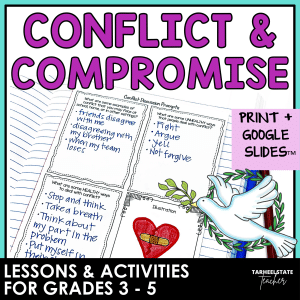
 You can do each of these suggested conflict resolution activities for students with a reflection journal and materials you have around the classroom, but if you want some of the work done for you, you can check out my full Conflict Resolution and Compromise SEL unit, complete with lesson plans that make it super easy to implement and enjoy!
DEFINING CONFLICT RESOLUTION FOR STUDENTS
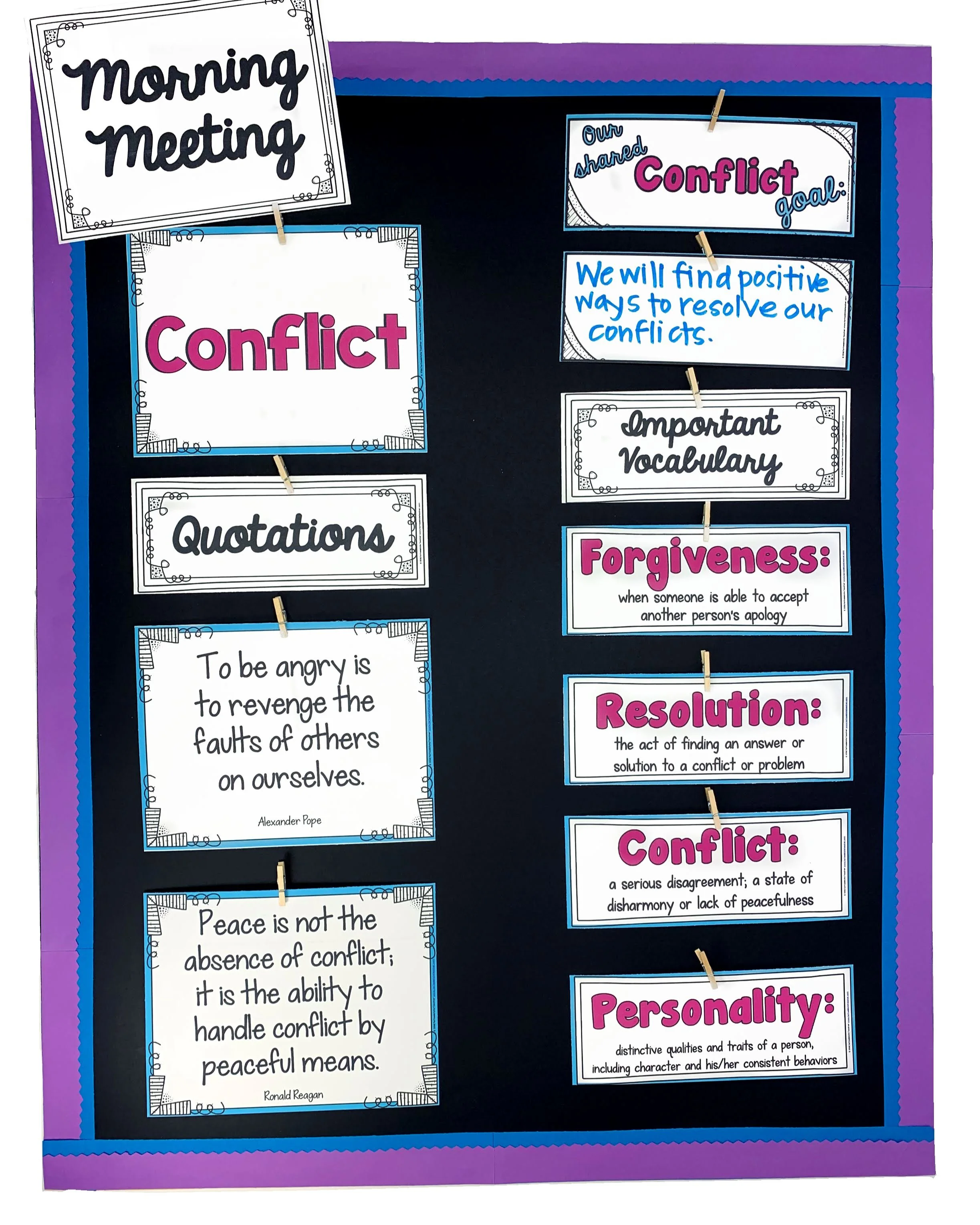
To define conflict resolution for my students, I first define conflict as “a serious disagreement; a state of disharmony or lack of peacefulness, and I define resolution as “the act of finding an answer or solution to a conflict or problem.” So, conflict resolution is “the act of finding an answer or solution to a serious disagreement, conflict, or problem.”
 During SEL-focused Morning Meetings, I display a bulletin board of the topic we are learning about. This bulletin board contains key vocabulary, related quotations, and anchor charts that we develop together throughout the unit.
TEACHING 5 WAYS TO HANDLE CONFLICT
After introducing the SEL topic of CONFLICT and defining conflict resolution for students, I like to dive into the 5 basic conflict resolution styles. These are the main ways that nearly every conflict has or can be solved:
- Accommodating the other person or group
- Avoiding the conflict altogether
- Coming up with a Compromise
- Collaborating and Problem Solving Together
- Using Competition or Competitive Strategies to Decide
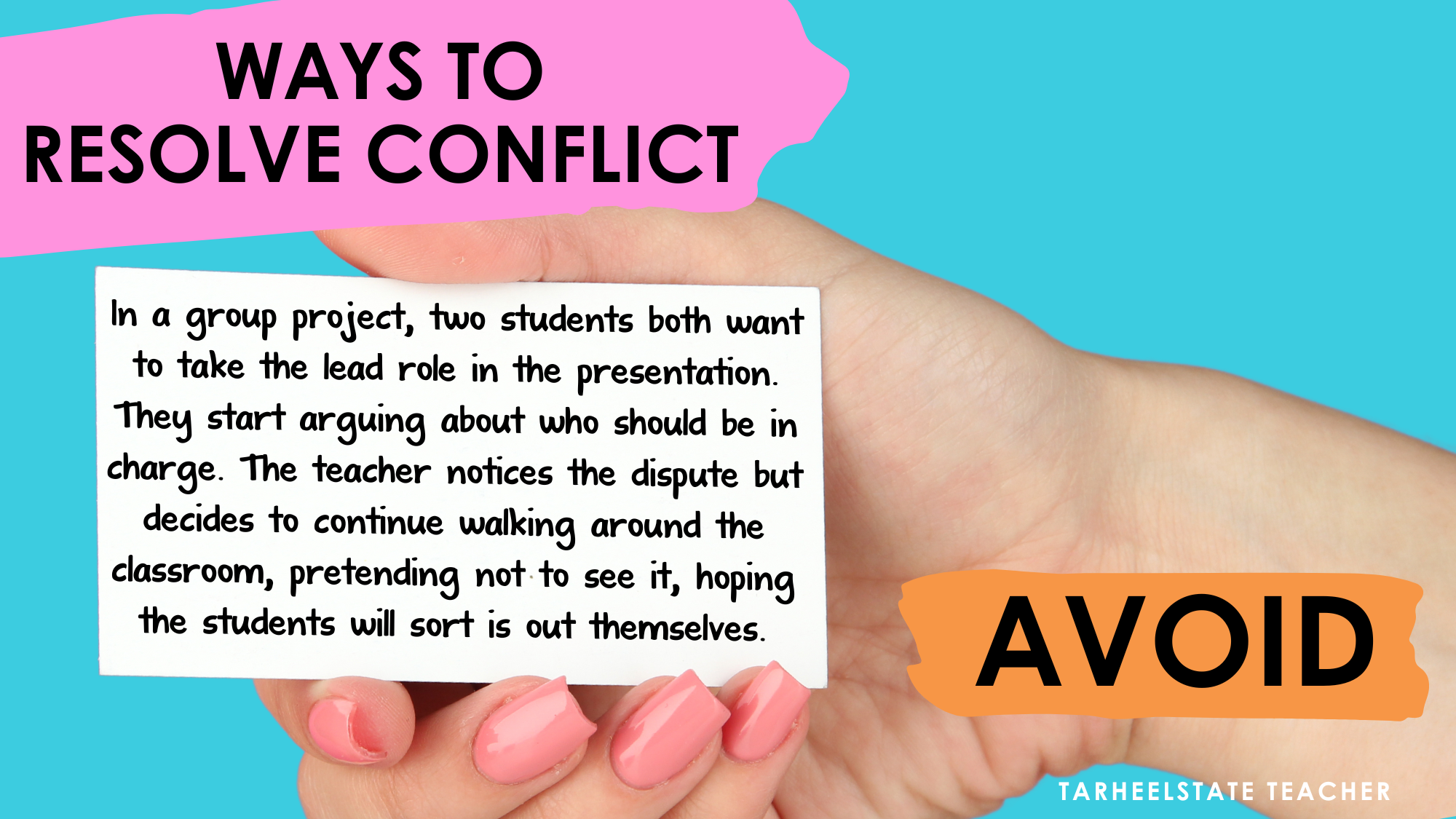
After introducing the 5 Conflict Resolution Styles, I offer a few situations and examples that may arise in a classroom. Students discuss where one might choose to apply that particular resolution style and generate possible positives and negatives (pros and cons) for each way of resolving a conflict.
The purpose of this conflict resolution activity is to help students understand that not all conflicts hold the same importance, that it’s important to listen to the opinions and feelings of others when involved in a conflict, and we don’t always need to (or even should) get our way. Different resolution styles may be more effective depending on the situation. In the future, students will be better equipped to step back and analyze a problem or conflict before immediately responding to it.

CONFLICT RESOLUTION STRATEGY #1: ACCOMMODATING OTHERS
In the context of conflict resolution, accommodating others means prioritizing their needs and preferences over your own. This approach is driven by a genuine desire to maintain harmony and foster positive relationships. Accommodating is most effective when the issue at hand isn’t critical to the person being flexible but is significant or important to others.
CONFLICT RESOLUTION EXAMPLES FOR STUDENTS

After discussing the conflict resolution situation examples such as this one with students, I engage them in generating a pros and cons list of responding to the conflict by accommodating others.
PROS:
- promotes a friendly, cooperative environment
- makes peers and others feel valued and loved
- shows others respect and consideration
- shows flexibility and that you are not one who always needs to get their own way
CONS:
- The accommodating student may feel like their voice doesn’t matter if they are always the one giving in
- The accommodating student may feel less engaged and involved in group projects or dynamics
- potential of being taken advantage of
- The accommodating student may not be developing their leadership, courage, or confidence skills
- The person being accommodated may not learn how to accommodate others if they are always getting their way or surrounded by less determined individuals
CONFLICT RESOLUTION STRATEGY #2: AVOIDING THE DISAGREEMENT
Avoiding conflict might seem counterintuitive, but sometimes it’s the best approach. This style involves stepping back, staying neutral, or even withdrawing from the situation altogether. Avoiding can be particularly useful when the conflict is minor, or emotions are running high, and a temporary escape can help everyone gain perspective and return to the discussion with a clearer mind.
CONFLICT RESOLUTION EXAMPLES FOR STUDENTS
PROS:
- prevents escalation
- buys time
- temporarily reduces stress
- temporarily protects relationships
CONS:
- issues remain unresolved
- build-up of tension
- missed opportunities for growth
- potential for negative impact on self-esteem
CONFLICT RESOLUTION STRATEGY #3: COMPROMISE
Compromising is about finding a middle ground where each party involved in the conflict makes concessions. Think of it as a shared sacrifice to achieve a mutually acceptable solution. Compromise is especially handy when a quick resolution is needed, or the stakes are balanced on both sides.
CONFLICT RESOLUTION EXAMPLES FOR STUDENTS

PROS:
- mutual satisfaction
- quick resolution
- balances interests
- preserves relationships
- reduces hostility
CONS:
- partial satisfaction
- possible resentment
- encourages minimal effort
- potential for superficial solutions that do not address the underlying issue
CONFLICT RESOLUTION STRATEGY #4: COLLABORATION & PROBLEM SOLVING
Collaboration, or problem-solving, is a highly effective conflict resolution style that emphasizes working together to find a win-win solution. This approach values open communication and creativity, encouraging all students to share their perspectives and brainstorm solutions that address everyone’s needs. Collaboration is particularly beneficial for resolving complex conflicts where the outcome is significant for everyone involved.
CONFLICT RESOLUTION EXAMPLES FOR STUDENTS

PROS:
- high-quality solutions
- mutual satisfaction
- strengthened relationships
- shared ownership
- enhanced communication
CONS:
- time-consuming
- complex process
- requires high level of commitment
- potential for frustration
CONFLICT RESOLUTION STRATEGY #5: COMPETING
Competing is a more assertive conflict resolution style where one person aims to achieve their goals, sometimes at the expense of others. This approach might involve using authority, influence, or persuasive arguments to win the disagreement.
CONFLICT RESOLUTION EXAMPLES FOR STUDENTS
PROS:
- quick decisions
- clear outcomes
- encourages assertiveness
- can effectively protect one’s interests
- encourages preparation
CONS:
- can create hostility and resentment between parties
- losing party may feel undervalued
- potential for escalation
- neglects collaboration
- short-term solution
By giving students the knowledge and power to understand and apply these conflict resolution styles in a variety of situations and settings, they can navigate disagreements more effectively, whether in the classroom or in broader social interactions. Each conflict resolution style has its place, and knowing when and how to use it can make a significant difference in fostering a positive and inclusive classroom environment.
SOURCES:
- https://online.hbs.edu/blog/post/strategies-for-conflict-resolution-in-the-workplace
- https://knovator.com/blog/conflict-management-styles/
If you’re looking for more ways to keep building conflict resolution and compromise skills with your students, here are some other resources you may be interested in:
- 6 Conflict Resolution Steps for Students walks through a clear, student-friendly process for working through conflict that gives students a reliable framework they can turn to whenever disagreements arise.
- Teaching Conflict Resolution Skills in the Classroom shares practical strategies and lesson ideas for making conflict resolution a natural, ongoing part of your classroom community.
- Books about Resolving Conflict, Compromise, & Friendship highlights a diverse collection of read alouds that open the door to meaningful conversations about navigating disagreements, finding common ground, and maintaining healthy relationships.
- Complete Conflict Resolution & Compromise SEL Unit for upper elementary—this unit includes all of the activities you see in this post, editable lesson plans, suggested read alouds, student notebooks, and a bulletin board to help your unit make a lasting impression!
Let’s continue helping students grow into thoughtful, solution-focused problem solvers.
NEED A DONE-FOR-YOU CONFLICT RESOLUTION SKILLS AND COMPROMISE UNIT?
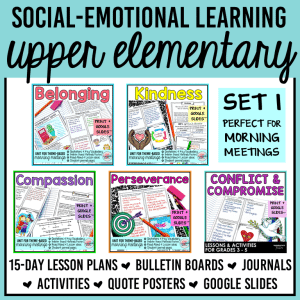
The Conflict Resolution & Compromise SEL-Morning Meeting unit is a 25 day unit for upper elementary. It includes
 25 Days of Printable & Editable Lesson Plans — includes suggested read alouds, discussion questions, conflict resolution activities, extension ideas, and linked online resources
Student Journals & Activities — conflict resolution-related discussion prompts, self-reflection and goal setting exercises, and social emotional learning worksheets to deepen students’ understanding of conflict resolution and compromise, with activities like Role Playing & Reflection with Conflict Situation Cards, Analyzing the 5 Types of Conflict Resolution Styles, Flipping to an Attitude of Compromise, Creating Steps for Resolving Conflict, and more!
Conflict Resolution Bulletin Board that includes important vocabulary like conflict, forgiveness, resolution, compromise, and trade-off and inspirational quotations for a visual reminder of your conflict resolution and compromise lessons
Google Slides — Teacher and student versions to implement this unit digitally or use as visual prompts and discussion starters on your interactive whiteboard